
Small timber decks for Chipping Campden cottage gardens, shaped around steep corners, stone walls and tight spaces so they sit comfortably beside the honey-coloured stone.
Cottage gardens in Chipping Campden rarely come in neat rectangles. They climb behind stone walls, step down in terraces or squeeze into a courtyard between outbuildings. That makes them lovely to sit in, and awkward to build on.
A deck can be a neat answer when the ground is uneven or the soil is thin and stony, because it creates a level area without moving much earth. We build timber decking for town and village gardens around Chipping Campden, and every layout starts with a look at the plot, the walls and the way you want to use the space.
Honey-coloured stone has a warm, quiet look, and timber can either complement it or fight it. Softer, natural-toned boards and simple edges usually look right, with little fuss around the balustrade. In a small garden we try to keep the deck proportionate, large enough for a table and a couple of chairs but not so big that it swallows the planting. Corner decks, L-shaped layouts and platforms wrapped round an existing feature can make use of awkward spots. We also think about how the deck will be seen from inside the house, since in a cottage the garden is often viewed through a small window.
With a sloping cottage garden, the frame does most of the clever work. Posts can be set at different heights so the top of the deck stays level, and short steps then link it to the lawn or path. Dry stone and mortared walls need care: footings should not push against them, and the deck should leave a gap so air can move and water can drain. Thin soil over rock can make digging slow, so we may use alternative supports. Where there is a drop, handrails are needed, and we design them to look neat rather than bulky.
Older cottage gardens are often shaded by walls, hedges and mature trees, which means decking stays damp for longer. Sweep it regularly, brush off moss, and cut back growth that touches the frame. A fresh coat of stain or oil every so often protects the surface, but check the underside and posts too. When posts go soft at the base or joists sag, boards alone will not fix it. In that case replacing the frame, perhaps with a slightly different layout, tends to be more worthwhile than another round of patching.
We work in Chipping Campden and across the north Cotswolds, including Broadway, Moreton-in-Marsh and Shipston-on-Stour. The town is small and built almost entirely in local stone, and many of its cottages have modest or sloping gardens, so a lot of our advice here is about making the most of limited space. Narrow lanes can make deliveries awkward, so we talk through access and parking at the first visit. If you are in a conservation area or have a listed home, it is worth checking what is allowed before you commit to any design, and we are happy to talk it through.
We also take on garden decking work in nearby Broadway, Moreton-in-Marsh, Shipston-on-Stour.

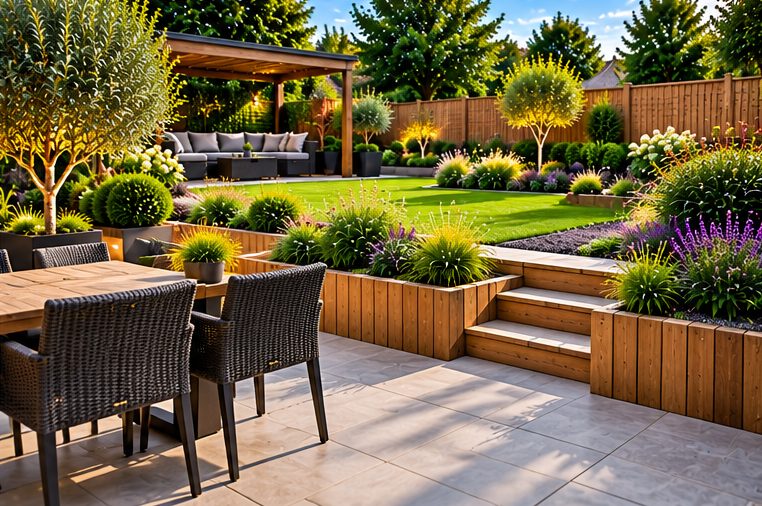


Images on this page are illustrations only.
“Jim and Dan did a brilliant job on my 90ft conifer. Its a lot safer now and I have more light in the garden...”
“The boys did an excellent job... pruned my trees back and remove one tree that had split...”
“The guys were prompt & proffesional removed an old ash for me thanks guys”
Yes, when it is kept in proportion. A compact deck can give a level seating area on awkward ground without taking over, and leaves room for planting around its edges.
Usually. Footings and supports are chosen to suit what we find, and sometimes we raise the frame on adjustable supports instead of digging deep. We check the ground at the visit.
Possibly. Listed buildings and conservation areas can have extra rules, even for garden structures. Check with the local authority before work begins, and we can supply drawings or details if needed.
SPR Trees & Landscapes, 6 Rose Avenue, Worcester, WR4 9PY
Tell us what you need in Chipping Campden and we will get back to you, usually the same day.
Prefer to talk? Call 07542 451291 or WhatsApp us.