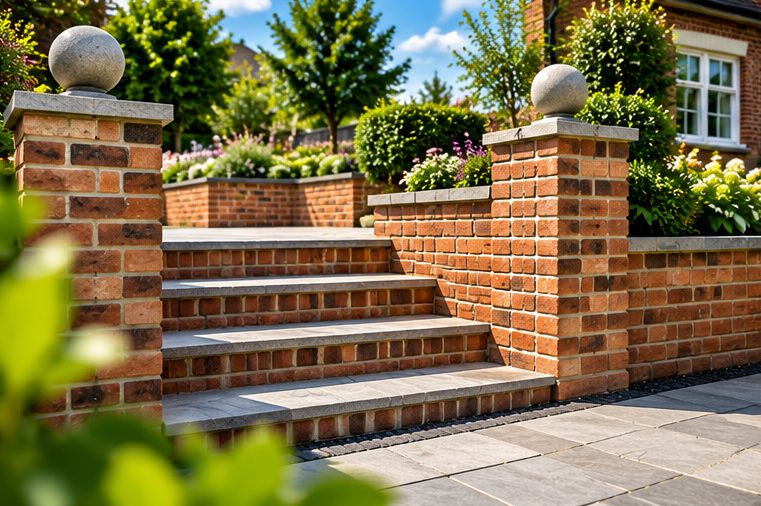
Bricks do not have to be plain. Used with a bit of thought, they can turn a flat boundary or a dull corner of the garden into something people stop and look at. Decorative garden brickwork covers a wide field: patterned panels in walls, brick-on-edge borders, curved edging round lawns, inset plaques, arches, and rounded or stepped features that catch the light.
The detail is where the skill lies, because decoration only works if the structure underneath is sound. This guide explains the main options, what each one involves on site, and the choices that homeowners in Worcester and nearby parts of Worcestershire, Herefordshire and Gloucestershire usually need to make before work starts.
The simplest decorative step is a change of bond. Flemish bond, which alternates the long and short faces of the brick along each course, has a traditional look that suits older brick houses. Stretcher bond is plainer and quicker. Beyond this, a wall can carry a band of contrasting brick, a diaper pattern formed from darker headers, or a recessed panel framed by piers. Open work, where bricks are laid with gaps, makes a pierced screen that lets light and air through while keeping some privacy. Each pattern needs more setting out and more cutting than a plain wall, so the labour is greater. A neat result relies on getting the first courses perfectly level, which is why patterned work is slower.
Not all decoration is vertical. Brick laid flat or on edge makes a crisp border between lawn and bed, or between gravel and paving, and it holds its line far better than plastic edging. Curved edging needs a lot more patience, because each brick is cut or gapped to follow the curve, and the mortar joints have to be kept consistent. Semi-circular steps, round planters and curved seat walls all follow the same rule. Bricks laid over a firm, compacted base with a mortar bed will stay put, while those pushed into loose soil will shift after the first hard frost. If you want a curve, mark it out with a hose or a string line before deciding.
Look at the colour of your house, existing walls and paving before ordering anything. Matching exactly is difficult, as weathered brick differs from new, so many people either go for a close match or deliberately contrast. Reclaimed bricks bring character and a softer tone, though quantities and quality vary and not all are frost-resistant. New facing bricks made for exterior use give a consistent result. Blue engineering bricks work well as a contrast band or a damp-proof course because they hardly absorb water. Whatever you choose, ask to see a sample laid in daylight, and think about how it will look after a few seasons rather than on the day it is finished.
The most frequent problem is decoration being added to a structure that has not been built to carry it. A tall, thin wall with fancy panels will still lean if the footing is poor. Another is choosing a brick that suits the eye but soaks up water, so the face spalls in the first winter. Overdoing it is a risk as well: three patterns on a single wall can look busy, and a restrained feature usually ages better. Finally, check how you will clean and maintain it. Recessed details collect leaves and moss, and tight curves are harder to repoint later, so it pays to keep the design realistic.
Decorative work is priced on time more than on materials. A short run with a detailed pattern may take longer than a long plain wall, because every course needs setting out and checking. Curves, arches and cut bricks add hours. The choice of brick, mortar colour and any special shapes make a difference, and so do access and ground conditions, as with any build. Foundations still matter, even for a modest feature. When you compare quotes, make sure each one describes the pattern, the type of brick, the joint finish and who will clear away the waste. Vague descriptions often hide differences in quality.
If you have a picture of a feature you like, send it over using the buttons on this page. SPR Trees and Landscapes will talk through what is realistic in your garden, visit to measure up and suggest a sensible scale. We will give you a free quotation, and if a simpler option achieves the same effect we will say so. A short chat before any drawing is done often saves a lot of changes later.
For decorative garden brickwork in Worcester or the surrounding towns, call or WhatsApp 07542 451291, or use the form below and tell us about the job.
Images on this page are illustrations only.
See all Brickwork Services services in Worcester →
Sometimes. New panels, copings or a contrasting band can be added if the wall behind is sound. If it is leaning or cracked, it is usually better to repair or rebuild first. We will check the condition when we visit.
Yes, and it can be especially effective there. A single patterned panel, a curved bed edge or a brick-edged path adds interest without taking up space. Keeping to one or two details usually looks more successful than trying several.
Very little. An occasional brush to remove moss and debris is usually enough. Over time the mortar may need repointing, and recessed details can collect leaves, so it helps to keep the design simple enough to clean.
Tell us about the job and we will be in touch, usually the same day.
Prefer to talk? Call 07542 451291 or WhatsApp us.