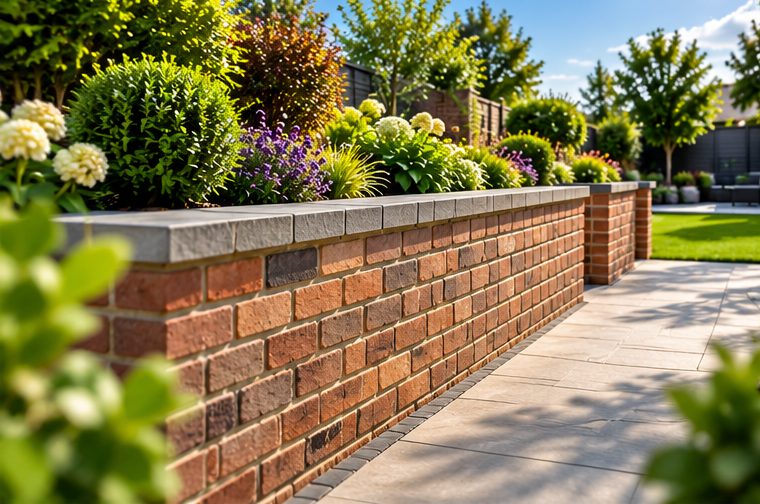
A raised bed made from brick is one of the few garden features that looks right on day one and still looks right a decade later. Raised brick planters give you deeper soil, a tidy edge and a place to sit or lean, and they stop a border from slumping onto the lawn or path.
This guide is for homeowners in Worcester, Malvern, Evesham and the surrounding villages who are thinking about brick flower beds and want to understand the build before asking for a quote. We cover foundations, drainage, brick choice, height and the mistakes that cause bulging or staining.
Timber sleepers and boards are quick and cheap to put in, but they rot, split and eventually need replacing, usually just when the planting has matured. Brick behaves differently. A properly built brick wall carries the weight of wet soil without moving, does not need treating or painting, and can be matched to the house or to an existing garden wall so the new feature looks as though it was always there. Brick also copes well with the heavy clay soils common around Worcester, where wet ground pushes hard against a thin edge. The trade-off is that brick takes longer to build and needs a proper base, so it suits permanent planting schemes better than a bed you expect to move in two or three seasons.
The taller the bed, the more the soil pushes outwards, so height decides almost everything about the build. A low bed of a few courses sitting on a compacted base can often be built as a single skin of brick. Once you go higher, or if the bed sits on a slope, a thicker wall, a concrete footing or reinforcement may be needed. A good bricklayer will look at what the ground is made of, how much water collects there and whether the bed sits against a fence, a path or a boundary. Never build tall beds straight onto soft turf or loose topsoil. Settlement shows up as cracks within a year or two, and by then the planting is in and moving anything is a nuisance.
A sealed brick box full of soil holds water like a bucket unless it is designed to drain. Weep holes along the base course let surplus water escape, and a layer of free-draining stone or coarse material inside keeps roots from sitting in a puddle. A membrane against the inside face helps slow staining and efflorescence, the white salty bloom that can appear on new brickwork. Fill the bed with decent topsoil mixed with compost rather than raw subsoil, and leave a few centimetres below the top course so watering does not flood over the edge. If the bed backs onto a house wall, keep the soil well below the damp proof course and talk to us before you build.
Matching bricks to the house is often possible but never exact, so many people deliberately choose a clear contrast instead of a near miss. Frost-resistant bricks suitable for exposed brickwork are the sensible choice outdoors, since ordinary interior bricks can flake after a few winters. A coping of brick on edge, stone or clay gives a finished top and a handy seat, and sheds water away from the face of the wall. Mortar colour and joint style change the look more than most people expect, so ask to see a small sample panel before committing. Curved planters look softer in a modern garden but take noticeably more time to set out and cut than straight runs.
No honest quote can be given without seeing the site. The length and height of the walls, the number of corners and curves, the type of brick, and the depth of foundations all change the amount of labour and material. Access matters too: if bricks and sand have to be wheelbarrowed through a side passage or up steps, that adds time. Groundwork such as removing turf, levelling a slope or taking away spoil is another variable, as is whether you want planting included. Where the bed meets an existing wall or patio, extra care and making good may be required. Giving us rough measurements and a few photos makes a first conversation much more useful.
If you are weighing up brick flower beds for a front garden, a patio edge or a vegetable plot, get in touch and tell us roughly what you have in mind. We will arrange a visit, look at the ground and the existing brickwork, and explain what we would build and why. The quotation is free and there is no obligation, and you are welcome to ask about alternatives if brick turns out to be more than the job needs. We cover Worcester and the surrounding parts of Worcestershire, Herefordshire, Gloucestershire and north Warwickshire.
For raised brick planters and flower beds in Worcester or the surrounding towns, call or WhatsApp 07542 451291, or use the form below and tell us about the job.
Images on this page are illustrations only.
See all Brickwork Services services in Worcester →
There is no single limit. Low beds of a few courses are straightforward, but taller walls hold far more soil pressure and need stronger foundations and sometimes a thicker wall. We assess the ground and the height you want before suggesting a build, rather than copying a standard design.
White salty bloom can appear on new brickwork as it dries and usually fades over time. Good bricks, a lining behind the face and proper drainage reduce it. Keeping soil below the top course and not letting water sit against the wall also helps keep the brick looking clean.
Sometimes, but it is better to fill with a mix of decent topsoil and compost over a drainage layer. Heavy clay or poor subsoil can leave plants struggling. If your garden soil is good, we can reuse some of it, which also reduces the amount of material taken away.
Tell us about the job and we will be in touch, usually the same day.
Prefer to talk? Call 07542 451291 or WhatsApp us.