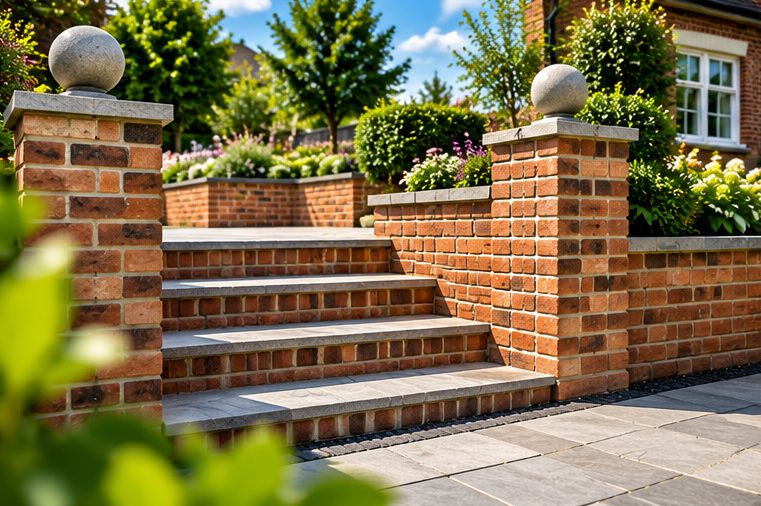
Most garden walls give a warning before they fail. A hairline crack that widens after a wet winter, a coping stone that rocks when you lean on it, or a face that has started to flake like old biscuit are all signs worth taking seriously. The question homeowners in Worcester, Malvern and Evesham ask us most is whether a wall can be saved or has to come down.
The honest answer depends on why it moved. Garden Wall Repairs make sense when the fault is local and the structure underneath is sound. Garden Wall Rebuilding is the better route when the footing has gone, the wall leans past plumb, or the bricks themselves are breaking up. This guide explains how to tell the difference before anyone picks up a trowel.
Start by walking the length of the wall and looking at it from both ends, sighting down the top edge. A smooth bow or lean suggests movement at the base. A stepped crack that follows the mortar joints in a diagonal line usually means one end has settled. Vertical cracks at a pier or corner can simply be old thermal movement, particularly where no expansion joint was ever built in. Next, press a screwdriver gently into the joints. If the mortar powders and falls away to a finger's depth, the wall is losing its bond even though it still stands. Finally, check the bricks themselves. Surface spalling on a few units is a repair job. Widespread flaking, especially at the bottom courses where moisture sits, tells you the brick may not survive another round of frost.
Brickwork Repairs are the sensible answer when the damage is contained. Cutting out and replacing a handful of spalled bricks, raking out and repointing a failed section, resetting loose copings on fresh mortar, and stitching a single crack with bonding bars all fall into this group. These jobs keep the original character of the wall, which matters on older boundaries where a close colour match is hard to buy new. The condition is that the wall is still vertical and the foundation is not the cause. If you repair the face while the footing keeps moving, the crack will come back within a season or two. Repointing alone is covered in our separate piece on repointing garden walls, so here the focus is on structural mending.
A wall should usually come down and be rebuilt when it leans beyond its own thickness, when it has bulged at the middle, or when the foundation is missing or too shallow for the height. Tall walls that were built with no piers, and walls holding back soil they were never designed for, fall into this category. Rebuilding does not have to mean throwing everything away. Sound bricks can often be cleaned and reused, which helps colour matching. The new work gets a proper concrete footing, a damp proof course, wall ties or piers at sensible spacing, and weep gaps where soil sits behind it. It costs more effort than a patch, but a repair on a failing wall is money spent twice.
No two walls are alike, so we do not quote by the metre from a photograph. The main drivers are the length and height, how much has to be taken down and carried out, and whether the old bricks are fit for reuse. Access matters too, because a wall behind a terrace with no side gate means every barrow of material goes through the house or over a longer route. Ground conditions, such as clay that swells and shrinks or tree roots pressing on the footing, can add groundwork. Brick matching, coping type and any reinstated gate pillars all feed in. Anything that involves a boundary shared with a neighbour is worth discussing with them first, so there are no surprises on the day.
Send us a few clear details and we will arrange a visit. Tell us roughly how long and tall the wall is, what you can see wrong, whether it forms a boundary or retains soil, and how we would get materials to it. A short note on when the damage first appeared helps, as does mentioning any nearby trees. We cover Worcester and the surrounding parts of Worcestershire, Herefordshire, Gloucestershire and north Warwickshire, and quotations and advice are free. If we think a lighter repair will do the job, we will say so rather than suggest a full rebuild.
For garden wall repairs and rebuilding in Worcester or the surrounding towns, call or WhatsApp 07542 451291, or use the form below and tell us about the job.
Images on this page are illustrations only.
See all Brickwork Services services in Worcester →
It can be. A wall that leans noticeably or rocks when pushed may fall without warning, particularly in wind or after heavy rain. Keep children and pets away from it, avoid leaning on it, and have it looked at promptly. Tall walls beside paths or neighbouring gardens deserve extra caution.
Only if the crack is caused by failed mortar and nothing else. If the wall has moved because of a poor footing, tree roots or soil pressure, repointing hides the symptom and the crack returns. We check the cause first, then decide whether repointing alone is sensible.
Often it can, because sound bricks from the old wall are cleaned and reused where possible, with matching bricks sourced for any gaps. A perfect match on weathered brick is difficult, and we will tell you plainly how close we expect to get before work starts.
Tell us about the job and we will be in touch, usually the same day.
Prefer to talk? Call 07542 451291 or WhatsApp us.