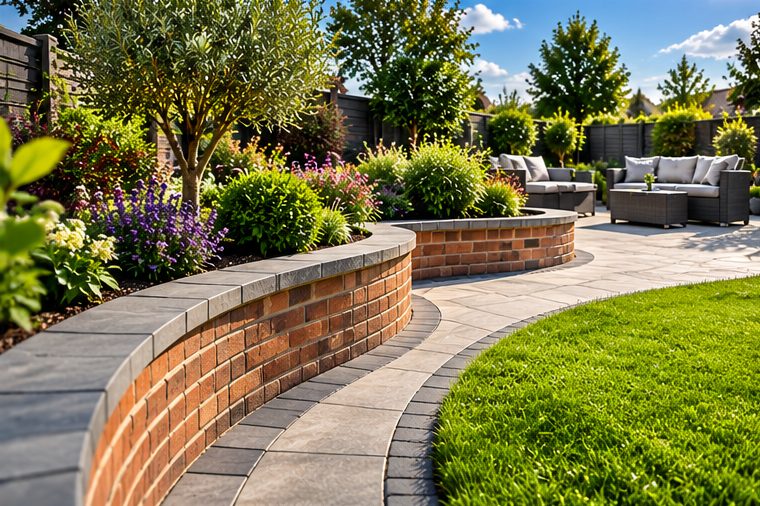
Most garden walls do not fail all at once. The mortar between the bricks wears back a little each winter, the joints open up, and water gets into places it should never reach. Repointing garden walls is the job of raking out that tired mortar and refilling the joints so the wall can shed water properly again. Done in good time it is a modest repair.
Left alone, the same wall can start to lose faces off its bricks, lean at the top, or shed whole sections after a hard frost. This guide explains how to tell whether your wall needs repointing, what the job involves, and what to check before anyone starts work, whether you are in Worcester, Malvern or out towards Evesham.
Walk along the wall with a screwdriver and a bit of patience. Mortar that is sound resists a prod. Mortar that crumbles, powders or drops out in lumps has finished its working life. Look for joints recessed more than a finger-nail deep, green growth sitting in the gaps, and bricks that wobble when pushed gently. Also check the top course and any capping, because water that enters from above does the most damage. White crusty staining on the brick face is a sign that moisture is moving through the wall. None of this means the wall must come down. Often it only needs the mortar replaced, with a few individual bricks cut out and swapped where the faces have blown.
The most common mistake is filling old joints with a mix that is harder than the bricks around it. An older, softer brick, as found in many period gardens around Worcester and Hereford, needs a mortar that is weaker than the brick so that moisture and movement escape through the joint rather than through the brick face. A newer, dense engineering brick can take a stronger mix. Sand matters too: colour and grain size decide whether the repair blends in or shows as a patch. Lime-based mixes suit old walls; cement-based ones suit modern walls. A good bricklayer will test a small area first so you can judge the colour once it has dried.
The old mortar is raked out to a depth of roughly twice the joint width, using hand tools or a careful grinder, and the dust is brushed away. The joints are dampened so the bricks do not suck the water from the new mix, then the fresh mortar is pressed in firmly in layers. Finally it is struck to a profile, such as flush, weathered or slightly recessed, depending on the wall. Weathered joints shed rain well. Deeply recessed joints look dramatic but hold water. Work is well done when frost is not forecast and the wall will not bake in direct summer sun, because mortar that dries too fast or freezes early stays weak.
Three things shape any quote. The first is area: the length and height of the wall, and whether both faces need doing. The second is access, such as ivy to clear, planting in the way, or a wall that backs onto a neighbour's garden. The third is condition. A wall needing only light repointing is a very different job from one where many bricks need replacing or coping stones need relaying. Joint depth also matters, since deep raking takes longer. A site visit is the honest way to price it, because photos rarely show how far the mortar has gone. Ask for the scope in writing, including what happens to any bricks that crumble when raked.
Newly pointed mortar needs a few days of protection. Hessian or sheeting over the top keeps rain from washing out the surface, and in hot weather a light misting stops it drying too quickly. Avoid pressure washing for a good while. Keep soil and compost banked up against the wall from sitting there, as it holds damp against the brick. Cut back climbers that root into the joints. If the coping is cracked or missing, sort that at the same time, otherwise rain will come straight back in from above and undo the repair within a few winters.
If you are not sure whether your wall needs repointing or something more, send us a few photos and a rough idea of its length and height, and tell us the nearest town. We will arrange a free look, explain what we see in plain terms, and quote for the work in writing. If the wall is leaning or bulging we will say so honestly, since that is a rebuild question rather than a repointing one. Use the call or WhatsApp buttons on this page to get in touch.
For repointing garden walls in Worcester or the surrounding towns, call or WhatsApp 07542 451291, or use the form below and tell us about the job.
Images on this page are illustrations only.
See all Brickwork Services services in Worcester →
Prod the joints with a screwdriver. If the mortar crumbles, powders or sits well back from the brick face, it needs attention. Loose bricks, green growth in the gaps and white staining on the brickwork are also signs. A wall that leans needs a closer look.
Small areas are possible with patience, but matching the mortar mix to the brick is where most people go wrong. A mix that is too hard can damage softer bricks. For a long or tall wall, or one in a period garden, it is usually worth having a bricklayer do it.
It depends on the mortar, the exposure and how well the wall sheds water. A well-matched mix on a wall with sound coping usually lasts for decades. A wall that is damp from the ground or open to driving rain will wear back sooner.
Tell us about the job and we will be in touch, usually the same day.
Prefer to talk? Call 07542 451291 or WhatsApp us.