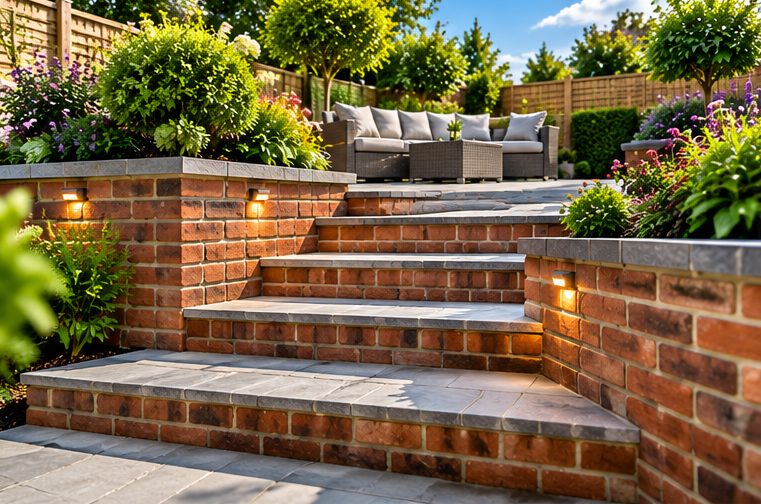
A new wall changes a garden more than almost any other job. It sets the edge of your space, gives privacy, and, if it is built properly, it will still be standing long after a timber fence would have been replaced twice. Garden wall construction is not complicated in principle, but the parts that matter most are the ones nobody sees once the job is finished: the trench, the concrete and the way the bricks are tied together.
This guide is written for homeowners in Worcester and the surrounding areas of Worcestershire, Herefordshire, Gloucestershire and north Warwickshire who are weighing up a wall for the first time. It covers what the work involves, which decisions are yours to make, what tends to go wrong, and how to get a sensible quotation that you can compare like with like.
Brick garden walls cost more to put up than a fence, and it is better to be upfront about that. What you are paying for is longevity and a solid feel. A well built wall does not rot, does not blow over in a gale, and does not need treating every couple of years. It also deadens road noise far better than timber, which is useful on a busy route into Worcester or Droitwich Spa. Brick also suits many of the older houses in the area, where a low front wall in a matching or sympathetic brick can finish the frontage in a way a fence never will. The trade-off is that a wall is hard to change once built, so it is worth taking time over the height, the line and the finish before any digging begins.
Every sound wall starts below ground. A trench is dug to a depth and width that suits the height of the wall and the type of soil, then filled with concrete to make a level footing. Heavy clay, which is common across much of Worcestershire, moves with the seasons, so the footing needs to go down far enough to get past the zone that swells and shrinks. Trees close to the line matter too, because roots draw water from clay and can cause movement. A wall without proper foundations may look fine for a year or two and then start to lean or crack. If a quote seems light, ask what is going into the ground, because that is where corners are most often cut.
The brick you choose affects both appearance and durability. Facing bricks made for outdoor use cope with frost and wet far better than cheap interior or common bricks, which can flake after a few winters. Colour and texture should be looked at in daylight and, ideally, as a sample panel rather than a single brick. The bond, meaning the pattern the bricks sit in, changes the look and the strength. Walls beyond a certain height or length usually need piers, which are thicker columns at regular intervals, plus movement joints to take expansion. The top deserves thought as well. Coping stones or a brick-on-edge course shed water away from the face and stop the wall soaking up moisture from above, which is a common cause of early staining.
Garden boundary walls raise a few questions that are worth settling early. Height is the main one. As a general rule, walls beside a road or highway have lower limits before planning permission is needed than walls elsewhere, and listed buildings or conservation areas can carry extra restrictions. You should also be clear about who owns the boundary. If it is shared, talk to your neighbour before work starts, and be aware that building on or over the line can lead to disputes. Checking the title deeds and talking it through in advance costs nothing. If you are unsure whether your plans need approval, your local planning department can tell you, and we are happy to explain what we will need to know when we visit to measure up.
No two walls cost the same, and quotes only make sense when they describe the same job. The length and height are obvious factors, but access matters just as much. If materials and spoil have to be carried through a house rather than wheeled round the side, labour goes up. The ground conditions, the depth of foundation, the choice of brick, the type of coping and the number of piers all feed into the figure. Taking down and removing an old fence or wall first is a separate task. Slopes add work because the wall has to be stepped to follow the ground. When you compare quotes, check that each one covers foundations, disposal of waste, finishing and clearing up, so you are not surprised later.
If you are thinking about a new wall, the easiest next step is to get in touch with SPR Trees and Landscapes at 6 Rose Avenue, Worcester, using the buttons on this page. Tell us roughly where the wall is going, how long and tall you would like it, and whether anything is being removed first. A few photos help. We will arrange a visit, measure up, look at access and ground conditions, and talk through brick, bond and coping with you. The quotation and advice are free, and there is no pressure to go ahead.
For garden wall construction in Worcester or the surrounding towns, call or WhatsApp 07542 451291, or use the form below and tell us about the job.
Images on this page are illustrations only.
See all Brickwork Services services in Worcester →
Often not, but it depends on height and position. Walls next to a highway have lower limits, and listed buildings or conservation areas can add rules. Check with your local planning department if you are unsure, and we can tell you what to look for when we visit.
A properly founded wall built with outdoor-grade facing brick and sound mortar can last for many decades. Poor foundations, weak bricks or missing copings shorten that life, which is why we look at the base and the top as closely as the face.
Yes. The wall is usually stepped so each section stays level while following the ground, or built to a consistent height above the slope with deeper foundations on the high side. It takes more time and care, so a slope will affect the quote.
Tell us about the job and we will be in touch, usually the same day.
Prefer to talk? Call 07542 451291 or WhatsApp us.