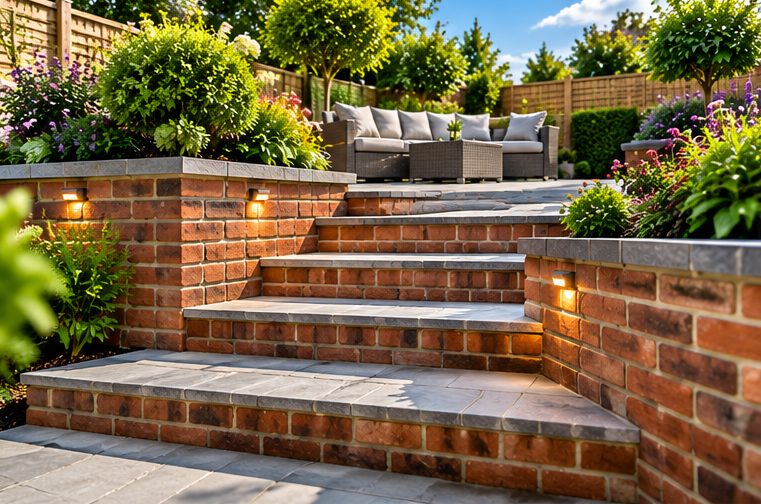
Almost every sloping garden in Worcester, from the terraced back plots near the river to the gentler gradients around Malvern, eventually needs a safe way up and down. Garden steps construction in brick is one of the most hard-wearing answers, but only when the hidden parts are done properly. A neat face with nothing solid underneath will rock, crack or slump within a couple of winters.
This guide explains how brick garden steps are actually built, what decides the effort involved, which choices are worth thinking about before anyone picks up a trowel, and the mistakes we are asked to put right most often. It is written for homeowners across Worcestershire, Herefordshire, Gloucestershire and north Warwickshire who want to understand the job before asking for a quote.
The first decision is how much height the steps need to climb and how much length you can give them. Measure the vertical rise from the bottom to the top of the bank, then divide it by a comfortable riser height to see how many steps you need. Garden steps are kinder underfoot when each riser is shallow and each tread is deep, so a long gentle flight beats a short steep one every time. If space is tight, the flight can turn through a landing or follow the contour of the bank in a dog-leg. Take a note of where the water runs after heavy rain, because a flight that cuts across a wet line needs extra thought. Also check what sits at the top and bottom, such as a gate, a patio edge or a lawn, since the first and last step must meet them cleanly.
A brick step is heavy, and brick does not forgive movement. Each flight needs a firm, level base dug down into undisturbed ground, normally a compacted stone sub-base topped with concrete where the load or soil calls for it. In clay soils, which are common across much of Worcestershire, the base needs to go deeper and be kept free of standing water, because clay swells and shrinks through the seasons. Where the steps retain a bank, the earth behind them also needs support, and sometimes small wing walls or a short retaining wall are part of the same job. The bricks themselves should be frost-resistant types suited to outdoor use, laid in a suitable mortar mix, not left to whatever happens to be in the garage. Skipping this stage is the single most common reason steps fail.
Once the structure is up, the finish decides how safe the steps feel. Treads can be laid in brick on edge, in paving slabs, in clay pavers or in natural stone, and each one gives a different grip when wet. Smooth, glazed surfaces are a poor choice under trees where moss builds up. Every tread needs a slight fall so water runs off, and the nosing, the front edge, should be consistent so nobody trips on one odd step. Matching new brick to existing house or wall brickwork is possible but never exact, since old bricks weather and fade, so it helps to decide whether to blend or deliberately contrast. Handrails, low lighting and a grippy tread surface are worth considering if the steps will be used by older relatives, children or in the dark.
No two flights of steps cost the same, which is why a sensible quote follows a site visit. The main factors are the number of steps and their width, the amount of digging and spoil to be moved, how awkward access is for barrows and materials, and whether a retaining element is needed alongside. The choice of brick and treads matters too, as does whether there are existing steps to take out first. A curved or angled flight takes longer to set out than a straight one. Ask for the quote to list the base build-up, the mortar type, the tread material and what happens to the waste, so you can compare like with like and avoid surprises halfway through.
If you would like brick steps built or an old flight repaired, get in touch with SPR Trees and Landscapes at 6 Rose Avenue, Worcester. We cover Worcester and the surrounding parts of Worcestershire, Herefordshire, Gloucestershire and north Warwickshire, and quotations are free. It helps to send a few photos of the slope, a rough idea of the top and bottom positions and any ideas about brick colour. We will talk through the options honestly, including cases where a simpler approach would suit the plot better than brick, and then confirm the work in writing. If the existing flight is simply worn or loose, we will say so plainly, because a repair can sometimes make more sense than starting again.
For brick garden steps in Worcester or the surrounding towns, call or WhatsApp 07542 451291, or use the form below and tell us about the job.
Images on this page are illustrations only.
See all Brickwork Services services in Worcester →
Well-built brick steps on a solid base can last for decades, but that depends on the foundation, the frost resistance of the bricks and how well water drains away. Steps that fail early usually have a weak or wet base, not worn-out brick.
Most ordinary garden steps do not, though changes to ground levels, work near a listed building or steps beside a highway can be different. If you are unsure, check with your local council before work starts. We can talk through your plot during a visit.
Yes, this is very common. The bank is cut back to take the base, and the soil behind is usually supported so it cannot slump onto the steps. How much support is needed depends on the soil, the height and the amount of water running through.
Tell us about the job and we will be in touch, usually the same day.
Prefer to talk? Call 07542 451291 or WhatsApp us.