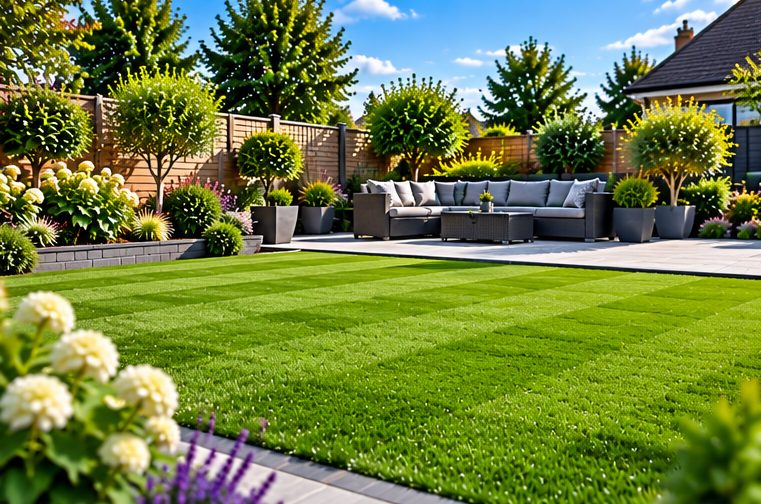
A lawn that looks lovely in the photographs on a turf supplier's website can look very different after a summer of football, trampolines, paddling pools and a dog who treats it as a racetrack. If you are planning a family garden lawn, the choices that matter are made long before the turf arrives, and most of them are in the soil. Good New Lawns for Gardens are built from the ground up, not rolled out over whatever happens to be there.
This guide covers New Lawn Installation from a practical angle for homes in and around Worcester, Droitwich Spa and Cheltenham. We look at how to decide between turf and seed, what ground preparation really involves, how to make the lawn tougher, and what to avoid in the first few weeks. It sits alongside our articles on lawn turf and ground preparation, so the focus here is on planning for a busy household.
Turf gives an instant green surface and can be used lightly within a few weeks, which is why most families choose it. Seed costs less in materials and lets you pick a hard-wearing mix, but it needs patience, protection from birds and a longer wait before anyone can play on it. For a Family Garden Lawn Installation, the usual compromise is good-quality turf with a rye-based blend for wear tolerance. Shaded gardens under trees are the exception, since grass struggles in deep shade whichever way it is laid. In those spots, a shade-tolerant mix, thinner trees or a different surface may serve you better. Wherever possible, lay turf as soon as it arrives, because rolls stacked in the sun begin to yellow within a day or so.
Grass roots into the top layer of soil, so what you lay it on matters. Heavy clay, common in parts of Worcestershire and Herefordshire, holds water and compacts easily, while very sandy or stony ground dries out fast. The old surface is stripped, the ground is broken up, weeds and builders' rubble are removed, and topsoil is added where needed. Levels are raked to fall gently away from buildings, with no hollows that collect puddles. Where water lingers after rain, extra drainage may be needed before any turf goes down. Skipping this stage is the main reason new lawns patch and sink. Leave the soil slightly firm, not fluffy, so the turf is not left sitting on a loose cushion that will settle unevenly.
Turf is laid in staggered rows, like brickwork, with tight butt joints and no stretched pieces. Edges are trimmed with a sharp knife. Water begins straight away and needs to continue regularly, since turf dries out before roots knit into the soil beneath. In warm weather that can mean daily soaking. Keep everyone off it until the turf resists a gentle tug, which usually takes a couple of weeks but depends on conditions. First cuts should be light with the blades set high. Feed in line with the season and avoid heavy traffic, furniture and play equipment until the roots are well established.
Lawn size is the starting point, but the amount of preparation usually decides the effort. Clearing an old lawn, taking away spoil, importing topsoil, fixing levels and adding drainage all add work. Access matters, because pallets of turf are heavy, and a long walk through the house changes the job. The grade of turf, turf versus seed, and any new edging or borders play a part. Timing can affect availability, since supplies and ground conditions change through the year. After a visit we can give a clearer figure than any rule of thumb. A larger lawn also needs more labour on laying day, so planning delivery and helpers properly makes a difference.
Tell us the size of the garden, how the family uses it, whether there are pets, and what is there now. A mention of drainage problems, shade, slopes and access helps. We will visit, look at the soil and levels, and explain what we recommend and why. Our quotations and advice are free, and we cover Worcester and the surrounding parts of Worcestershire, Herefordshire, Gloucestershire and north Warwickshire. If your garden would suit another surface better, we will tell you plainly.
For new lawn installation in Worcester or the surrounding towns, call or WhatsApp 07542 451291, or use the form below and tell us about the job.
Images on this page are illustrations only.
See all Turf Laying services in Worcester →
Autumn and spring are the easiest, as the ground is moist and temperatures are mild. Turf can be laid in summer with plenty of watering, but it is more demanding. Avoid laying on frozen or waterlogged ground.
Usually light use is possible after a couple of weeks, once the turf has rooted and resists a gentle tug. Heavy play and digging dogs need longer. Expect it to depend on weather and watering.
Common causes are drying out in the first weeks, compacted or stony ground beneath, poor drainage, or dog urine. Check the watering first, then look at the soil. We can help find the cause if patches persist.
Tell us about the job and we will be in touch, usually the same day.
Prefer to talk? Call 07542 451291 or WhatsApp us.