Almost every lawn ends up with a bald patch somewhere: under the washing line, where the paddling pool stood, or where the dog likes to run. Some patches fill in by themselves, but many just fill with weeds or moss.
This guide covers how to decide between seed, small turf patches or bigger work, with advice for homeowners in Worcester, Evesham, Malvern and around. Good Lawn Repairs start with working out why the grass failed, not just covering the problem.
Grass does not die without a reason. Compacted soil, shade, poor drainage, buried rubble, chafer grub damage, fertiliser or fuel spills and dog urine all leave different marks. If a patch keeps coming back, putting down more turf simply wastes it. Press a fork into the soil: if it barely goes in, compaction is likely. If water sits on the surface after rain, drainage is the question. Heavy clay can be sticky and cold in winter and baked hard in summer, so it often needs breaking up and improving before anything new will root. A few minutes of detective work saves a lot of effort. Take a photo of the patch each week to see whether it is improving, spreading or stuck.
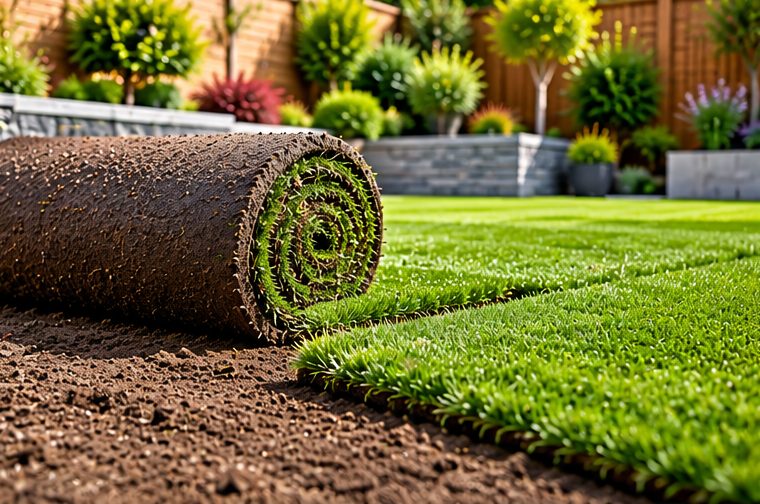
Overseeding suits small bare areas and thin lawns. It is cheaper but slow, needs regular watering and is vulnerable to birds and heavy rain. Cut turf gives a usable surface within weeks, which suits high-traffic spots such as the route from patio to shed. Turf Repairs and Patching works well when you cut out the damaged section in a neat square or rectangle, loosen the soil underneath, firm it, and lay a new piece to sit slightly proud to allow for settling. Butt the edges tightly, water in well and keep people off until roots take hold. Seed sown thinly into prepared soil usually does better than thick scatterings, and a light covering of fine compost helps it hold moisture.
Uneven lawns are a repair job too. Small dips can be lifted by cutting the turf in an H shape, peeling back the flaps, filling with a soil and sand mix, and putting the turf back. Humps may need to be cut and reduced. Worn paths from repeated walking are better dealt with by adding stepping stones or a proper path rather than relaying grass that will wear again. In areas where tree roots surface, some turf will always struggle and a ground-cover planting or mulch may be a more realistic answer than fresh grass. For hollows deeper than a few centimetres, fill in layers rather than all at once, or the turf will sink again as the soil settles.
Dog urine burns grass in rings with a green edge, and the damaged centre is usually better cut out and replaced. Watering the spot soon after the dog has used it helps dilute it. Children's play and garden furniture also cause wear. Tougher grass mixes, rotating furniture and giving the lawn a resting period all help. If most of the lawn is worn out, patching may not be worthwhile and a fuller renovation or relaying is the sensible route. We can talk this through on site. Marking the spot where a dog tends to go and training it to use a different area, such as a gravel corner, saves repeated patching.
The number and size of patches, the condition of the soil underneath and the type of turf all matter. Fixing levels, improving drainage and dealing with compaction add work. Access for barrows or machines, taking away old turf, and the season also play a part. A lot of small patches cost more per square metre than one open section because of the cutting and edge work. We prefer to see the lawn before saying what is worth patching and what is not.
If your lawn has bare spots, hollows or worn areas, send photos and tell us what has caused the damage as far as you know. We will visit, check the soil and drainage and advise whether patching, overseeding or relaying makes most sense. Quotations are free with no obligation, and we cover Worcester and nearby parts of Worcestershire, Herefordshire, Gloucestershire and north Warwickshire.
For lawn repairs and turf patching in Worcester or the surrounding towns, call or WhatsApp 07542 451291, or use the form below and tell us about the job.
Images on this page are illustrations only.
See all Turf Laying services in Worcester →
Spring and early autumn are usually kind to new grass, with milder temperatures and natural rainfall. Summer patching needs a lot of watering and winter work depends on frost. Soil that is not waterlogged or frozen is the main requirement.
It is better to remove the dead material and loosen the soil first. Laid over hard or thatchy ground, turf often fails to root properly. Preparation takes only a short time and greatly improves the odds of success.
Different grass types and ages show different colour and texture at first. Within a few weeks of mowing and feeding, the join usually blends in. Using similar turf and keeping the new piece well watered helps the match.
Tell us about the job and we will be in touch, usually the same day.
Prefer to talk? Call 07542 451291 or WhatsApp us.