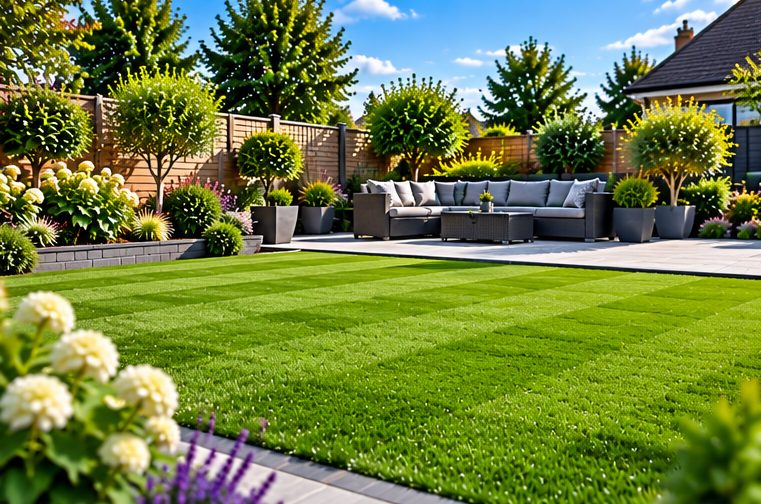
Most lawns do not fail overnight. They thin out, fill with moss, develop bare patches under the washing line, and slowly turn into something you stop wanting to look at. The good news is that many tired lawns can be brought back without ripping everything up. Lawn renovation means diagnosing why the grass is struggling and putting that right, then repairing the damage.
This guide is for homeowners in Worcester and nearby areas of Worcestershire, Herefordshire and Gloucestershire who want to know what is involved, what they can do themselves, and when it makes more sense to lift the lot and lay new turf.
Before spending anything, look at why the lawn failed. Moss usually points to shade, poor drainage, compaction or an acidic, starved soil. Bare patches might come from heavy foot traffic, dog urine, spilled fuel or leatherjacket grubs. Thin, yellowish grass often means hunger or drought stress. A lawn that is squelchy after rain probably has a drainage problem, which is common on clay soils across much of the Severn valley. Repairing the surface without tackling the cause only buys a short respite. A quick check by pushing a fork in to see how deep the roots go, and how tight the soil is, tells you a great deal.
A typical renovation follows a sequence. First, mow short and rake out the thatch and moss, which is a layer of dead material that blocks water and air. Scarifying machines do this faster and more thoroughly than hand raking. Next comes aeration, spiking or hollow-tining the lawn so air and water reach the roots, which matters most on compacted ground. A top dressing of sandy loam can improve levelling and drainage. Bare areas are then overseeded with a mix suited to the site, and a feed is applied. Finally, keep the new seed moist and off-limits until it takes. The work is usually done in early autumn or spring, when the soil is warm enough and rainfall is reliable.
Some problems do not respond to seed. Under trees, the combination of shade and root competition means ordinary lawn mixes struggle, and a shade-tolerant mix or a change of planting may serve better. On slopes, water runs off before it soaks in, and mowing can be awkward. Heavily compacted ground, such as a builder's yard that was turfed over, needs deep aeration or even cultivation before the grass has a chance. If the soil is mostly rubble, it may be more honest to replace the top layer. We would rather tell you that a section cannot be saved than watch you pay for a repair that fades by next summer.
If more than half the lawn is weeds, bare soil or moss, or if the surface is lumpy and uneven, renovation may just postpone the inevitable. In that case, stripping the old lawn, correcting levels and drainage, and laying fresh turf gives a more reliable result. Turf gives an almost instant lawn, whereas seeding takes months to establish. A hybrid approach is common: renovate the better sections and re-turf the worst. Whichever route you take, ask for the reasoning behind it, and be wary of anyone who recommends a total rebuild without looking at the soil, or who promises that a quick feed will fix everything.
Cost depends on the size of the lawn, its condition and how much of the work is mechanical. A light scarify and overseed takes less time than levelling a lumpy lawn or reworking drainage. Waste is a factor too, because the raked moss and thatch from even a modest lawn fills a surprising number of bags. Access for machinery, slopes, obstacles such as trees and borders, and the quality of seed or top dressing also feed into the figure. If turf needs removing, disposal adds to the work. When you compare quotes, check what is included, and whether aftercare advice is provided.
To get your lawn assessed, contact SPR Trees and Landscapes in Worcester through the buttons on this page. A few photos of the problem areas help, as does a note of any shade, pets or drainage trouble. We will visit, look at the grass and the soil, and suggest a realistic plan, whether that is renovation, a patch repair or new turf. The quotation and advice are free.
For lawn renovation in Worcester or the surrounding towns, call or WhatsApp 07542 451291, or use the form below and tell us about the job.
Images on this page are illustrations only.
See all Turf Laying services in Worcester →
Early autumn and spring usually work well, when the soil is warm and moist. Summer heat and winter frost both make it hard for seed to establish. If your lawn has been neglected, an autumn start gives the grass time to recover before the following season.
Only if the cause is dealt with. Raking out moss clears it for now, but if shade, compaction or poor drainage remain, it tends to return. Aeration, feeding and improved light or drainage all help keep it away.
It depends on the condition. If the lawn is mostly grass with a few bare areas, renovation is sensible. If it is largely weeds, moss or uneven ground, new turf often gives a better and more lasting result.
Tell us about the job and we will be in touch, usually the same day.
Prefer to talk? Call 07542 451291 or WhatsApp us.