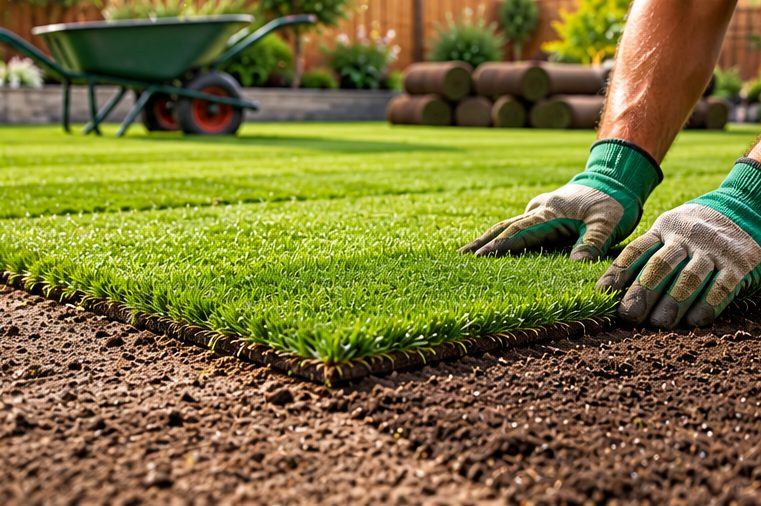
Turf is only as good as the soil under it. A lawn laid onto compacted, lumpy or stony ground looks fine for a few weeks, then shows dips, bare patches and yellow strips where the roots could not get down. In Worcestershire the situation is often made worse by heavy clay, builders' rubble hiding just below the surface, or a plot that has been walked on for years.
This guide covers lawn ground preparation step by step, including garden levelling for turf, topsoil supply and preparation, and the points that decide how long the work takes. Doing this stage properly costs time but is the main reason one lawn thrives while another struggles. A little patience here pays back for years.
Start by walking the plot after rain. Where does water sit? Where is the ground hard underfoot? Dig a few spades deep and see what the soil is made of. Clay feels sticky and smears, sand feels gritty, and old building sites often reveal bricks, tile and concrete a short way down. Mark any pipes, cable runs, drains and manhole covers, because levels around them must stay correct. Note trees and large shrubs whose roots will compete with new turf for moisture. A slope towards the house is a warning sign that needs fixing before any turf is laid.
Old lawn, weeds and debris are removed first, either by lifting the turf with a machine or by cutting it by hand on smaller gardens. Stones, rubble and roots are picked out. Compacted ground then has to be broken up, usually by digging or rotovating, so water and roots can move down. Rotovating clay when it is wet makes things worse, so timing matters. Weeds with deep roots, such as docks and bindweed, need dealing with now, because turf will not smother them. Any waste is taken away or put to good use elsewhere, and the area is left roughly to its new shape.
Levelling does not mean flat in every case. A lawn needs a slight fall so surface water drains away from buildings, with no hollows that hold puddles. Using string lines, boards and a level, high spots are cut down and low spots filled, and the surface is raked and trodden or lightly rolled to firm it. Be careful about burying turf or poor soil in hollows, as it will sink later. Where levels change dramatically, a small retaining edge or step might be better than trying to force a slope into a gentle lawn. Any change near trees needs care, since piling soil against a trunk can harm it.
New turf needs a layer of good, crumbly topsoil to root into, normally several centimetres deep once settled. If existing soil is thin, stony or heavy clay, quality topsoil is brought in and mixed or spread over the loosened base. Soil is described by its texture, stone content and organic matter, and a cheap, weedy load causes years of trouble, so ask what is being delivered. The topsoil is spread, raked, firmed and raked again until it is even and fine on top, with a pre-turf fertiliser if needed. Leave it a day or two so any hollows show before turf arrives.
The effort depends on lawn area, access for machinery, the amount of old turf and rubbish to remove, how uneven the ground is, the depth and volume of topsoil needed, and any drainage work. A quote should say how deep the preparation goes, how much topsoil is included and what happens to waste, so that it can be compared fairly. Heavy plant, hand digging and slopes all change the labour involved, and so does the distance to the place where soil and turf can be delivered. Awkward access means more wheelbarrow work. If drainage pipes or a soakaway are needed, mention them early, since they can alter levels across the entire lawn.
SPR Trees and Landscapes will visit your garden at no charge, check the levels and soil, and explain what preparation is needed before turf. We are at 6 Rose Avenue, Worcester, and work across Worcestershire, Herefordshire, Gloucestershire and north Warwickshire. Photos and rough dimensions help us give a realistic quotation. Describe the size, show photos from a couple of angles and tell us about any known problems such as boggy corners, rubble, or trees you want to keep. We will visit, probe the soil, and set out the steps needed to turn your plot into proper turf ground. No obligation attaches to a quotation, and you are welcome to ask how deep we would cultivate and what soil we would supply.
For lawn ground preparation in Worcester or the surrounding towns, call or WhatsApp 07542 451291, or use the form below and tell us about the job.
Images on this page are illustrations only.
See all Turf Laying services in Worcester →
This is rarely a good idea. The old grass rots under the new turf, leaves uneven ground and stops roots from reaching the soil. Removing the old surface and preparing the soil underneath is the more reliable route. Drainage matters here too.
It depends on what is already there. Reasonable existing soil may only need loosening and raking, while poor ground needs a proper layer of fresh topsoil. We check the soil on site and recommend a depth based on what we find. Thin soil usually shows quickly in summer.
Autumn and spring are often easiest because the soil is workable and rainfall helps new roots, but avoid frozen or waterlogged ground. Preparation can be done in advance, with turf laid shortly after, to keep the surface fresh. Seasonal weather plays a part.
Tell us about the job and we will be in touch, usually the same day.
Prefer to talk? Call 07542 451291 or WhatsApp us.