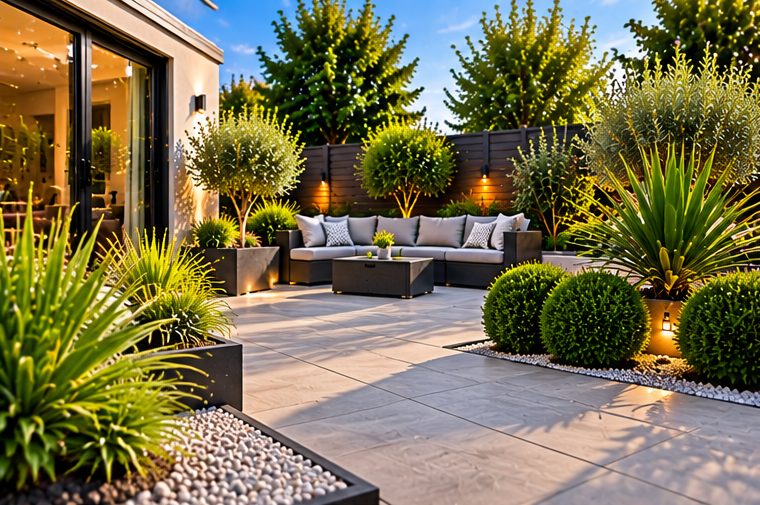
Gravel has a reputation as the easy option, and it can be, but only when the layers underneath are right. A thin scatter of stones laid straight onto soil turns into a weedy, rutted mess within a season. A well-built gravel garden, on the other hand, drains freely, stays tidy and asks for little more than the odd rake.
This guide is for homeowners in Worcester, Malvern, Evesham and nearby villages thinking about gravel garden installation. It explains how decorative stone gardens are built, what garden gravel landscaping really involves, how to add decorative garden stone features without creating a hard, lifeless space, and how to request a quote from SPR Trees and Landscapes.
Gravel suits dry, sunny borders, front gardens, courtyards, paths between beds and areas under trees where grass will not grow. It copes well with drought-tolerant planting, as it keeps moisture in the soil and reflects light. It struggles on steep slopes, where stones migrate downhill, and in heavily shaded spots where moss and leaf litter collect. Pets, children and bikes can scatter loose stone, and noisy gravel on a drive can be a plus for security or an irritation. Think about who walks on it, whether wheelie bins need to cross it, and how often leaves will fall onto it. A bit of honest planning prevents regret later.
A reliable gravel surface is a sandwich. First the area is cleared of weeds and roots and graded so water runs away from the house. A heavy-duty woven weed membrane goes over the soil, then the stone itself, usually in a layer thick enough to hide the fabric and resist rutting. Typical elements include:
There is a wide range of decorative stone, from rounded pea shingle to angular chippings, and from cream and buff to slate grey. Angular stone locks together and is better for drives and slopes, while rounded stone is softer underfoot but moves more. Larger pebbles and cobbles make good features around water or planting but are uncomfortable to walk across. Colour should relate to the house and boundary materials. Warm local stone tones can sit well with older brick or sandstone, while slate suits modern frontages. Ask for samples in daylight, as a wet and dry stone can look quite different. Washed stone stays cleaner and drains more freely than dusty, unwashed material.
A gravel garden can feel flat if it is just a sheet of stone. Introduce structure with larger boulders, a dry stream bed, stepping stones, a gravel path through planting, or raised timber and brick edging. Planting is what brings it alive, using grasses, lavender, sedums, thyme and other drought-tolerant plants that thrive in free-draining conditions. Planting holes are cut through the membrane and the plant firmed in, then gravel mulch is pulled back around the stem. Features such as a bird bath, a feature pot or low lighting give a focal point. Keeping hard surfaces broken up with greenery helps wildlife and keeps the space cooler in summer.
The area and the thickness of stone are central, because gravel is sold by weight and spreads further or less depending on depth. The type of stone changes the price considerably. Excavation, removal of the old surface or lawn, the sub-base, edging and membrane quality all matter. Access is relevant, since heavy bags or loads have to be moved to the garden. Planting, boulders and special features are additional. Sloping ground and drainage works add complexity. A visit lets us look at levels and make a sensible plan before pricing.
Contact SPR Trees and Landscapes with photos of the area, an idea of size and the look you want. Tell us whether you want planting, whether the area will be walked on or driven over, and any drainage worries. We will visit and give you a free written quotation.
For gravel and decorative stone gardens in Worcester or the surrounding towns, call or WhatsApp 07542 451291, or use the form below and tell us about the job.
Images on this page are illustrations only.
See all Low Maintenance Gardens services in Worcester →
Some will, as seeds blow in and settle on top of the stone. A good membrane stops most weeds from below, and a deep, clean layer of stone limits the rest. Occasional hand-weeding and raking keeps the surface tidy.
Enough to hide the membrane and resist ruts, which for most garden areas is a few centimetres. Drives and heavily used paths need a compacted sub-base and often stabilising grids. We confirm the right depth after seeing how the area will be used.
It can be, but loose stone tends to slide downhill. On slopes, we use edging, terracing or stabilising grids to hold it in place. Very steep ground may be better suited to planting or a different surface altogether.
Tell us about the job and we will be in touch, usually the same day.
Prefer to talk? Call 07542 451291 or WhatsApp us.