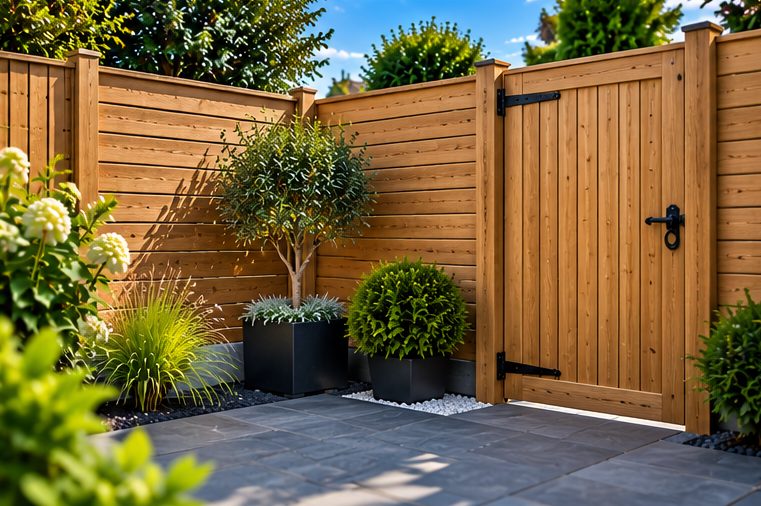
Walk past a cottage garden with boards that overlap in soft, uneven lines, and you are probably looking at waney edge. Each board is cut from the outside of the log, so one edge keeps a natural curve with the bark line still visible. Where a modern panel looks neat and flat, this style looks relaxed and slightly wild, which is exactly why people choose it. The look has become popular again in newer rural-edge developments too.
This guide explains what Waney Edge Fencing involves, how the boards go up, how the timber ages, and where it fits better than closeboard or lap panels. Whether your garden is a village plot near Malvern, an older house in Evesham or a country edge in Herefordshire, it is worth knowing the trade-offs before you commit.
Waney edge boards are sawn on three sides, with the fourth edge left natural. They are normally fixed horizontally or vertically to rails between posts, with each board overlapping the one below by a small amount. Because the edge is irregular, no two boards sit exactly alike, and the overlap hides the joins, giving a solid screen. Panels can be bought ready-made, though many installers build the fence in place for better control over height and ground slope. Because boards are thin at the waney edge, they need support, so rails are typically set at closer spacing than for flat panels to prevent warping. Vertical fixing sheds water quickly and suits slopes, while horizontal boards give a more traditional look but need a little more care to keep the lower edges from holding damp.
This fence belongs in gardens that want a natural frame: country settings, cottage borders, wildlife-friendly plots and rural edges. It works well with climbers, hedging and informal planting, because the texture softens rather than competes. It is less successful against crisp modern architecture or in tight urban courtyards where a clean line is wanted. Privacy is good because boards overlap, though wind loading means taller runs need sturdy posts. In exposed spots, a lower waney edge fence combined with planting can filter wind more calmly than a solid wall of wood. Next to a lane or bridleway it blends with hedgerow, whereas beside a sleek rendered extension it can look out of place.
The timber is usually softwood, treated before delivery. Left alone it fades to a silvery tone, which many people like, but a wood stain or preservative every couple of years extends its life, especially on the exposed side. Board edges that hold moisture can darken or grow algae in shaded gardens, so airflow and a gap above the ground help. Keep soil and mulch from piling against the bottom boards. Posts matter as much as boards, so concrete spurs or good timber posts set properly will outlast a fence set straight into damp earth. Check fixings annually after winter and replace any boards that crack. Gaps appear as boards dry and shrink, which is normal and not a sign of poor workmanship.
Because the boards are cut and fitted by hand, waney edge is usually more labour than a flat panel fence of the same length. Height, run length and ground slope shape the job, along with the number of corners, gates and changes of direction. Removing an old fence, working around trees or hard surfaces, and getting materials into a back garden all matter. Treatment choice and board thickness make a difference to the timber bill. We prefer to see the site and look at how the fence will meet the house and neighbours before quoting. Hand-built runs on steep ground, where each bay is stepped, take noticeably longer than a straight level length.
Tell us the length and height you are after, whether it is a boundary or a garden screen, and what is there now. Mention slopes, planting you want to keep, gates and anything unusual about access. We will visit, discuss board direction and post options, and give you a written quotation. Quotations and advice are free, and we cover Worcester and the wider areas of Worcestershire, Herefordshire, Gloucestershire and north Warwickshire. If another style would suit your plot better, we will say so.
For waney edge fencing in Worcester or the surrounding towns, call or WhatsApp 07542 451291, or use the form below and tell us about the job.
Images on this page are illustrations only.
See all Fencing Services services in Worcester →
It can be, if the posts and rails are well set. Overlapping boards catch the wind, so taller runs need stronger posts and close rail spacing. In very exposed gardens a lower fence, plus planting, copes better.
Yes. The overlap between boards forms a solid screen, and the uneven edge hides gaps. Privacy depends on the board overlap, the height and how well the timber is fixed as it dries and moves.
Yes, though many owners enjoy the natural weathered look. A breathable wood stain or preservative suits the rough surface well. Apply it on dry boards, and avoid thick paint that can peel on the textured finish.
Tell us about the job and we will be in touch, usually the same day.
Prefer to talk? Call 07542 451291 or WhatsApp us.