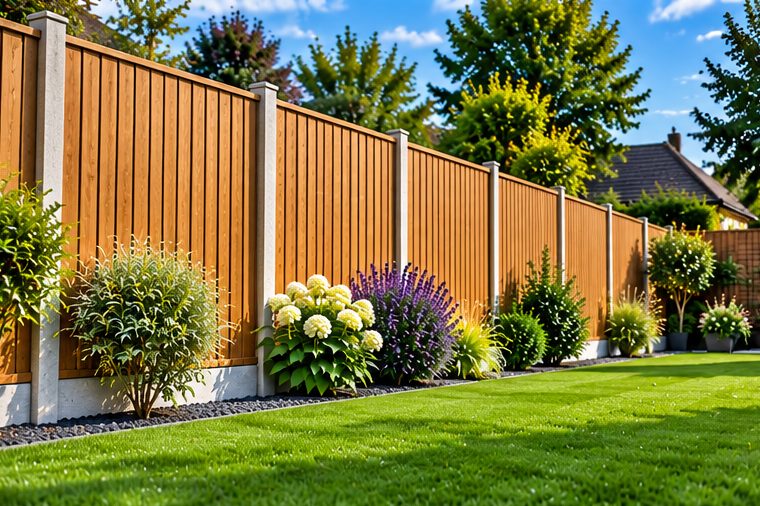
Overlap panel fencing is the familiar garden fence made of horizontal timber boards that overlap slightly, set within a light frame. It is quick to fit, easy to find and kind to a modest budget, which is why you see it in so many back gardens. It is not the right answer for every boundary, though, and knowing its limits will help you decide.
This page is for homeowners in Worcester, Pershore, Evesham and nearby villages weighing up overlap panel fencing against alternatives such as closeboard. It explains how the panels work, what posts to use, how long they last and how to approach a quotation.
An overlap panel is made from thin horizontal lap boards, each one sitting slightly over the one below, nailed to vertical timber framing at the sides and usually a rail across. The boards shed rain downward, and the overlap provides decent privacy. Panels arrive in standard widths, commonly in a handful of heights, so they suit straight runs and are fitted between posts one after another. The thin boards are what keep the weight and price down, but they are also what makes the panel less robust than a thicker alternative. Frames vary between suppliers, so it is worth asking how heavy and well-fixed the panel is rather than simply how it looks.
These panels are a practical choice in many ordinary situations. They suit sheltered suburban gardens, short boundaries between neighbours, quick screening of a bin area or shed and temporary or budget-conscious projects. Think about these points:
The main weakness of overlap panels is wind. A large flat panel catches gusts like a sail, and on open land or higher ground it can bend, split or blow out of its posts. Stronger posts, concrete bases and decent fixings go a long way, and for very exposed spots a heavier fence may be worth the extra outlay. Slopes are another issue, since the panels are rigid and have to be stepped down the hill, leaving triangular gaps that are then filled with a gravel board or cut-off. Thin boards can also split with age, and the framing nails may loosen. Checking after storms and fixing small problems early will extend the life of the fence.
Whatever the panel, the posts and base decide the fence's life. Concrete posts and gravel boards keep the panels out of damp soil, which is where timber normally begins to rot. Timber posts are fine when properly treated and set well above the ground line, though they are the first part to fail. Treat any cut edges and apply a preservative or stain once the panel has dried, since most come with only a light factory dip. A cap rail stops rain soaking into the top edge. Do not stack soil or compost against the bottom board, and keep climbing plants on trellis rather than the panels themselves.
Overlap panels are usually among the more economical choices, yet the final price still depends on the length, the height, the type and number of posts, and whether gravel boards are fitted. Taking down and disposing of the old fence, difficult access, uneven ground and any gates or awkward corners add to the work. A slope can mean more cutting and extra posts. Prices also vary with the quality of the panels, as thicker boards and stronger frames cost more but last longer. A visit allows the exposure and ground to be judged properly.
Contact SPR Trees and Landscapes with the length of the boundary, the height you want and a few photos of the existing fence or empty line. Let us know if the garden is exposed or sloping. We will visit, discuss whether overlap panels are the right match and provide a free written quotation.
For overlap panel fencing in Worcester or the surrounding towns, call or WhatsApp 07542 451291, or use the form below and tell us about the job.
Images on this page are illustrations only.
See all Fencing Services services in Worcester →
It can be, with strong concrete posts and good fixings, but it is more vulnerable to wind than closeboard. For very open or elevated sites, a sturdier fence may serve you better. We can look at the plot and advise on what is realistic.
It depends on exposure, treatment and how the posts are set. Panels on concrete posts with gravel boards generally last longer than those set directly in soil. Occasional re-treatment and prompt repair of storm damage help to extend their working life.
Yes, but because the panels are rigid they are stepped down the slope, leaving small gaps below that are filled with gravel boards or cut boards. On steeper ground, a closeboard fence that follows the contours more smoothly may look neater.
Tell us about the job and we will be in touch, usually the same day.
Prefer to talk? Call 07542 451291 or WhatsApp us.