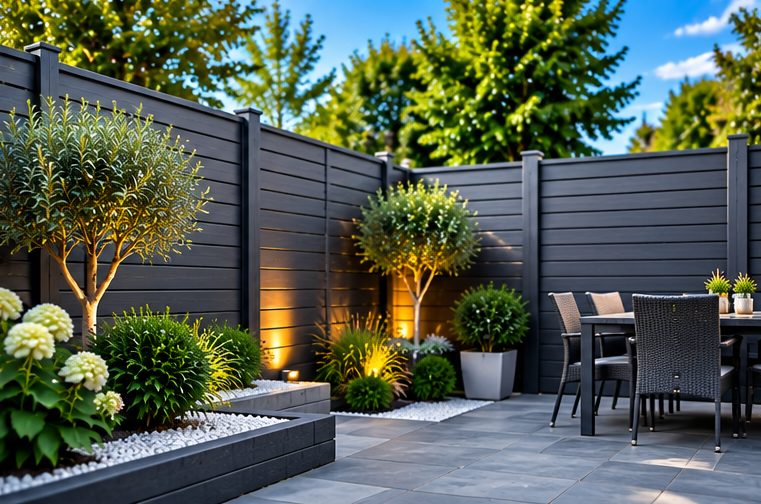
If you want a tough fence that stands up to wind and gives real privacy, closeboard is the traditional answer. It is built on site from overlapping vertical boards fixed to horizontal rails between sturdy posts, and it is usually sold under two names. You will see Closeboard Fencing described by some suppliers and Feather Edge Fencing by others, and they mean much the same thing: tapered boards that overlap along their edges.
This guide explains how the system is built, what makes one fence last longer than another, and the choices you need to make, for homeowners in Worcester and the nearby areas of Worcestershire, Herefordshire and Gloucestershire.
A closeboard fence starts with posts, set in the ground and fixed with concrete or a suitable post fixing. Between the posts run two or three horizontal arris rails, which are triangular in section. The feather edge boards, thicker at one edge and thin at the other, are then nailed vertically to the rails, each overlapping the one before it. Because the boards are fixed individually, the fence can follow a slope or a curve more easily than panel fencing, and there are no gaps for the wind to push through. Repairs are also simpler, since a single damaged board can be taken off and replaced without disturbing the rest of the run.
Most feather edge is softwood, pressure treated to protect against rot, and it comes in a range of thicknesses and lengths. Thicker boards are stronger but add to the cost. Treated timber is often brown or green when new and can be stained or left to weather to a silvery grey. Sawn timber takes stain well, while planed timber looks smoother but can be slipperier for climbers. Cut ends should be re-treated, and a coat of preservative every few years helps timber last longer. If you plan to paint or stain, wait a few weeks until the timber has dried out, because freshly treated boards hold a lot of moisture.
Most fences fail at the bottom. Timber that sits in wet ground will rot, which is why posts and gravel boards matter so much. A gravel board is a horizontal board along the base that keeps the feather edge boards clear of the soil, so only the cheaper and easily replaced board takes the damp. Concrete posts and concrete gravel boards last longer in wet ground, which is a real consideration on heavy clay across much of Worcestershire. Post depth is just as important: a tall fence in an exposed spot needs posts set deep and firm to resist wind, and in some cases concrete posts offer extra peace of mind.
Most garden fences are limited to two metres in height, and one metre beside a highway used by vehicles, unless planning permission has been granted. Check this early, particularly for front gardens and corner plots. Before any work, confirm whose fence it is. Many deeds show which side is responsible, though this is not always clear, and talking to your neighbour first avoids disagreements. Think about access too: if a long run is going in, the fitters need space to carry timber and mix concrete. Trimming back planting beforehand can save time and reduce the chance of damage.
Cost is shaped by the length and height of the run, the thickness of the boards, the type of posts and whether gravel boards are included. Slopes, awkward corners and gates add labour. If an old fence has to be taken out and disposed of, that is extra, as is working in tight or sloping ground where digging is difficult. Rock, old concrete footings and tree roots can also slow progress. Compare quotes carefully, because the specification can differ widely. Ask about post type, rail count, board thickness and what happens to the old fence.
To discuss a new closeboard fence, contact SPR Trees and Landscapes in Worcester through the buttons on this page. Tell us the rough length, the height you want and whether there is an old fence to remove. We will visit, measure up, check the ground and suggest a sensible specification. The visit and quotation are free, and we are happy to explain the differences between the materials so you can choose with confidence.
For closeboard and feather edge fencing in Worcester or the surrounding towns, call or WhatsApp 07542 451291, or use the form below and tell us about the job.
Images on this page are illustrations only.
See all Fencing Services services in Worcester →
The terms are used interchangeably in most cases. Both describe a fence made from overlapping tapered boards nailed to horizontal rails. Some suppliers use feather edge to mean the boards and closeboard to mean the finished fence.
It depends on the timber, the treatment, the posts and the ground. Fences that keep boards off the soil with gravel boards and use sound posts usually last far longer than those that do not. Re-treating the timber helps too.
Yes. Because the boards are fixed individually on site, the fence can follow the ground or be stepped. Posts must be set firmly, and the cost may rise slightly because of the extra cutting and fitting.
Tell us about the job and we will be in touch, usually the same day.
Prefer to talk? Call 07542 451291 or WhatsApp us.