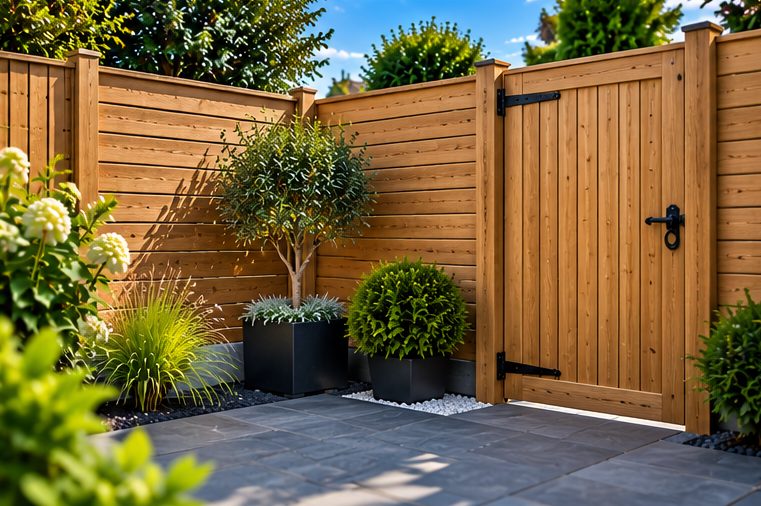
Ask a fencer why a fence fell down and the answer is usually the same: the bottom rotted. Wet ground attacks timber posts and boards at soil level, and even well-treated wood only lasts so long there. That is why many people now choose concrete fence posts and concrete gravel boards for the vulnerable part of the fence, keeping timber for the panels above.
This article explains how the two work together, where they make most sense, and what to think about before choosing them. It is written with Worcester and the nearby parts of Worcestershire, Herefordshire and Gloucestershire in mind, where heavy clay and wet winters are common.
A concrete post is cast with a series of slots down the sides, into which panels or boards slide. It does not rot, does not suffer from insect attack, and can stand in damp soil for decades. Concrete posts are heavier than timber, which makes them harder to handle, but once set they are stiff and resist leaning under wind load. They are usually available in several heights and in profiles for ends, corners and intermediate positions. Because the slots are fixed in position, the panels need to match the spacing, so measure carefully. The look is plainer than timber, and many people paint or stain them to blend in.
A gravel board sits along the base of the fence, between the posts, and lifts the panels clear of the ground. Concrete gravel boards slot into the same posts and are cast with a flat or slightly textured face. They keep the lowest edge of the fence away from soil and wet grass, so panels last longer. They also help hold back soil on a sloping garden or where beds sit higher on one side. On uneven ground you may need two stacked boards or a tapered cut to keep the panels level. A weak gravel board will crack, so choose a thickness suited to the load, especially where earth is piled against it.
Posts are set in holes dug to a suitable depth, usually around a third of the above-ground height or more, then concreted in and left to cure before panels are fitted. Alignment matters because the slots are rigid. Digging in heavy clay can be hard, and old tree roots or buried rubble may mean moving a post position. Concrete posts are heavy, so access for carrying them is a factor. Gravel boards are slid into the slots between the posts, followed by the panels. The sequence is simple, but small errors in spacing show up when the final panel does not fit, which is why measuring and setting out carefully pays off.
Concrete is not always the right call. On a short, low fence in a dry, sheltered spot, treated timber posts may do the job, especially if you prefer the natural look. Timber is also easier to adjust on site, which suits awkward boundaries or odd panel widths. A common compromise is to use concrete gravel boards with timber posts, or concrete posts only on the exposed or wettest stretches. Keep in mind that concrete can crack if it is hit by a vehicle or stressed badly, and it is not easy to repair. If you want a fence that can easily be altered later, timber may suit you better.
Concrete costs more than timber to supply, and the weight adds to labour. The number of posts, their height, the size of the boards and the footing all affect the total. Access is a significant factor, since a post may weigh as much as a person and have to be carried a long way. Digging conditions, removal of an old fence and any slopes add time. When comparing quotes, check whether posts, gravel boards and panels are all supplied, how deep the posts will be set, and who removes the old fencing.
If you are weighing up concrete or timber, get in touch with SPR Trees and Landscapes at Worcester through the buttons on this page. Tell us the length of fence, the ground type and whether you are replacing an existing fence. We will visit, measure and talk through what suits the site, giving you a free quotation and honest advice, including if timber would serve you better.
For concrete fence posts and gravel boards in Worcester or the surrounding towns, call or WhatsApp 07542 451291, or use the form below and tell us about the job.
Images on this page are illustrations only.
See all Fencing Services services in Worcester →
They last far longer than timber in wet ground, but not forever. They can crack if struck or if poorly set. A well-set concrete post will often outlive several sets of panels, which is the main reason people choose it.
Yes, in some cases. Timber posts need to have a routed groove or additional fixings to hold the board. A simpler route is to use concrete posts, whose slots are made for the boards. We can advise on a sensible combination.
They are heavy and need good alignment, so installation takes care and often two people. The slots are fixed, which means accurate setting out. For a few posts the work is manageable, but a full run is usually better left to a fencer.
Tell us about the job and we will be in touch, usually the same day.
Prefer to talk? Call 07542 451291 or WhatsApp us.