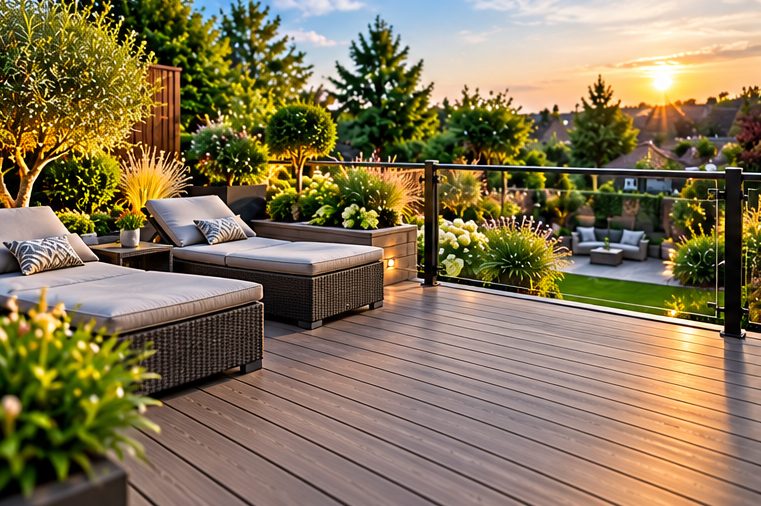
Cladding changes how a garden looks without rebuilding anything. A tired brick wall, a stained shed or an ugly concrete block outbuilding can be given a fresh face in a few days, and the finish stays fairly steady through the seasons.
This guide explains how composite garden cladding works, what it can and cannot cover, and the preparation that makes the difference. It is written for people in Worcester, Droitwich Spa, Malvern and nearby who want a neat result that does not need repainting every few summers.
Composite cladding boards are made from a wood fibre and plastic mix or from plastic alone, shaped for vertical or horizontal fixing to a frame. They are used on garden walls, raised planter sides, bin stores, sheds and the outside of home offices. Composite Wall Cladding works well on flat, solid backgrounds that are awkward to repaint, such as weathered render or dated blockwork. It is not a repair for a failing structure. If a wall is damp, bulging or crumbling, that must be sorted first, because cladding hides faults rather than curing them. A site visit should always begin with what lies behind the boards. Sheds, garden rooms and walls all move a little with the seasons, so fixings should allow for that movement.
Composite Garden Room Cladding is popular on timber-framed studios, summer houses and offices, where the original timber needs frequent coats of stain. The boards are fixed over a breathable membrane and battens, leaving a ventilated gap behind so moisture can escape. Corners, window reveals and door surrounds need proper trims, and the roof edge must be detailed so water does not run behind the boards. Check with your supplier for fire or building considerations if the garden room sits close to a boundary. Not every outbuilding needs approval, but it is wise to ask before work starts rather than after.
Good cladding begins with a flat, dry, stable surface. Loose render is removed, plants are cut back and any damp issues are investigated. Treated softwood or aluminium battens are fixed at the spacing the manufacturer specifies, packed to be level where the wall is uneven. Gaps at the top and bottom allow air to move, and a mesh stops insects entering the cavity. Fixings are hidden using clips or visible using screws depending on the board. A rushed frame produces wavy lines that no amount of careful cutting will disguise, so most of the real work happens before the first board goes up. Where the wall is rough, expect some time spent packing out the battens so the finished face reads straight in low evening light.
Boards come in smooth, grooved, woodgrain and slatted profiles, and in colours from warm browns to deep greys and black. Darker colours look smart but show dust and watermarks more and warm up in direct sun. Slatted designs with a backing panel suit privacy screens, while wider boards read as more solid. Think about how the cladding will meet existing features such as gates, lights and planting. A mixed approach, with cladding on a feature section and a plain finish elsewhere, often looks better than covering every surface. Ask to see samples outside in daylight, not only under shop lighting. Colour choices that echo the house windows or fencing usually look settled, while strong contrasts can look pasted on.
The area to be covered is the starting point, but the details add up. Height, number of corners, window and door cut-outs, trims and the condition of the background all alter the labour. Preparation work, such as removing old cladding or repairing a surface, is separate from the cladding itself. Choice of board and frame material changes costs, and difficult access slows everything down. Because Composite Cladding Installation depends so heavily on the wall behind it, we prefer to see the site before giving a figure.
Send us a few photos of the surface you want covered, the approximate size and what you hope to achieve. We will arrange a visit, check the structure behind, and explain the options plainly. Quotations are free and without obligation. We cover Worcester and the surrounding parts of Worcestershire, Herefordshire, Gloucestershire and north Warwickshire.
For composite garden cladding in Worcester or the surrounding towns, call or WhatsApp 07542 451291, or use the form below and tell us about the job.
Images on this page are illustrations only.
See all Composite Decking Installers services in Worcester →
No, the colour is built into the board and it does not need painting or staining. It will still need a wash now and then to remove dirt and algae, and some change in colour over the first few months is normal.
It should not. Damp must be traced and dealt with first, otherwise moisture gets trapped behind the boards. A ventilated frame, a breathable membrane and good drainage at the base help keep the wall behind dry over time.
Often yes, provided the shed is sound and the frame allows airflow. Lightweight sheds may need extra support, and roof edges need proper detailing. We look at the structure before recommending cladding or suggesting a different route.
Tell us about the job and we will be in touch, usually the same day.
Prefer to talk? Call 07542 451291 or WhatsApp us.