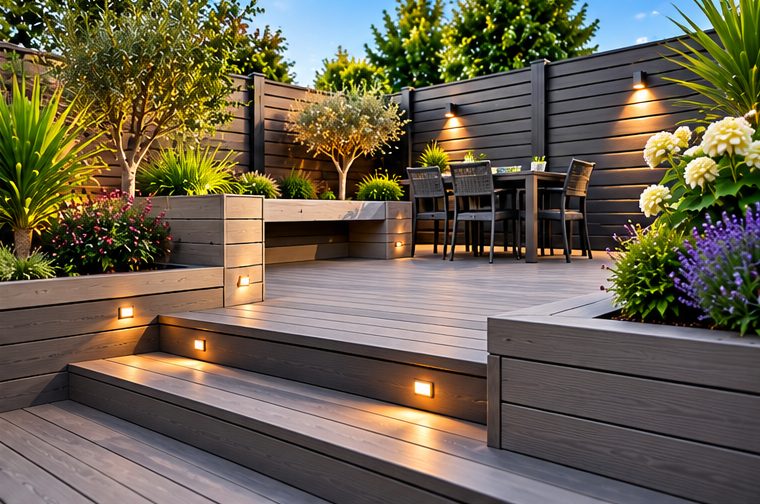
Timber fencing has served British gardens for generations, but it needs staining, it warps, and a storm can take a whole run of panels. Composite garden fencing is built from a blend of wood fibre and recycled plastics, and it is chosen mainly by people who are tired of repainting. It will not rot in the way softwood does, and it keeps its colour reasonably well.
It is not maintenance free, and it is not right for every boundary. This guide covers how composite fence installation actually works, the choices that matter, and what to consider if you only need composite fence panel replacement rather than a full new run. It is aimed at homeowners around Worcester, Cheltenham, Kidderminster and surrounding villages.
Most composite fencing combines recycled wood fibre with polymer, formed into boards that slot between posts. Some systems use hollow boards, others solid ones, and some have a capped surface that resists fading and staining. The posts may be concrete, aluminium, steel or composite, and the strength of the post matters more than the board, because wind loads on a solid fence are considerable. Colours range from soft greys to dark browns, and surfaces can be smooth or embossed with a grain. Because the boards are manufactured, they are straight and consistent, which gives a clean, modern look that suits contemporary gardens and decked areas.
Installation starts with setting out the line and checking where boundaries actually lie, because a fence on the wrong side of a boundary causes trouble. Post holes are dug to a depth suited to the fence height and ground, and the posts are set in concrete and left to cure before boards are added. Composite boards then slide into slots or clip into brackets, with gravel boards or a base rail at the bottom to keep them clear of soil. On sloping ground, the fence steps down in sections, or the boards are cut to follow the fall. Cutting is neat but the offcuts are not free, so measuring well saves material. Expect some noise and dust from drilling and cutting.
If one board or panel is cracked or marked, composite fence panel replacement is often possible without touching the rest of the run, provided the system is still available. This is where matching becomes tricky: colours weather slightly, and manufacturers update ranges. Keep a note of the brand and colour when the fence is installed, and keep a spare board or two if you can. Where posts have shifted or the fence has been struck by a vehicle or a fallen branch, the repair may involve resetting posts as well. Some systems cannot be repaired piece by piece and require whole panels replacing, so ask about this before choosing.
Composite is heavier than most timber, can feel less natural and usually has a higher starting cost than basic panels. In return it avoids annual treatment, resists insects and generally lasts longer in damp spots. It can still collect algae in shade, and a rinse with mild soapy water keeps it looking fresh. Colour can fade slightly in strong sun. It also expands and contracts with temperature, so fixings must allow for movement. For a boundary next to a neighbour, check who owns and maintains the fence, and talk to them before work starts. It is also worth asking how the supplier describes the surface, since capped boards generally stand up better to staining and fading than uncapped ones. Not every garden needs a premium product.
The quote depends on the length and height of the run, the system chosen, the type of posts, the ground conditions, any slopes and the removal of the old fence. Digging through roots, rubble or hard clay takes time. Gates, corners and changes in level add detail. For replacement work, availability of matching boards is a factor too. A written quotation should name the system and list posts, boards and finishing details. Delivery of long boards and heavy posts needs a clear route, so tell us about narrow gates, steps or parking limits at the property. If a neighbour shares the boundary, agree height and style with them before ordering, and make sure the old fence can be taken out without damage to their side.
SPR Trees and Landscapes can quote for composite fencing at 6 Rose Avenue, Worcester, and across Worcestershire, Herefordshire, Gloucestershire and north Warwickshire. Send us the length, a photo of the current boundary and any brand details if you are replacing panels. We will visit, discuss the options, and give you a free quotation. Photos of the existing fence from both sides, a rough sketch of the layout and the position of any gates help us prepare. If you are after composite fence panel replacement, send a close-up of a board end and the post, and tell us whether the colour has faded. A free quotation will list the system, posts and finishing items clearly, so you know what you are agreeing to.
For composite garden fencing in Worcester or the surrounding towns, call or WhatsApp 07542 451291, or use the form below and tell us about the job.
Images on this page are illustrations only.
See all Composite Decking Installers services in Worcester →
It needs far less than timber, with no staining or painting. An occasional wash to remove dirt and algae is still sensible, especially in shaded or damp gardens. Ignoring it altogether can leave green marks that are harder to shift later.
Often yes, if the same system is still sold and the posts are sound. Matching colour can be a problem on older fences. Take a photo of the fence and any markings on the boards, and we can advise during a visit.
Solid composite fences take wind like any solid fence, so strong posts set deep in concrete matter most. On very exposed plots, a slightly lower height or a design with gaps can reduce the load. We can talk this through on site.
Tell us about the job and we will be in touch, usually the same day.
Prefer to talk? Call 07542 451291 or WhatsApp us.