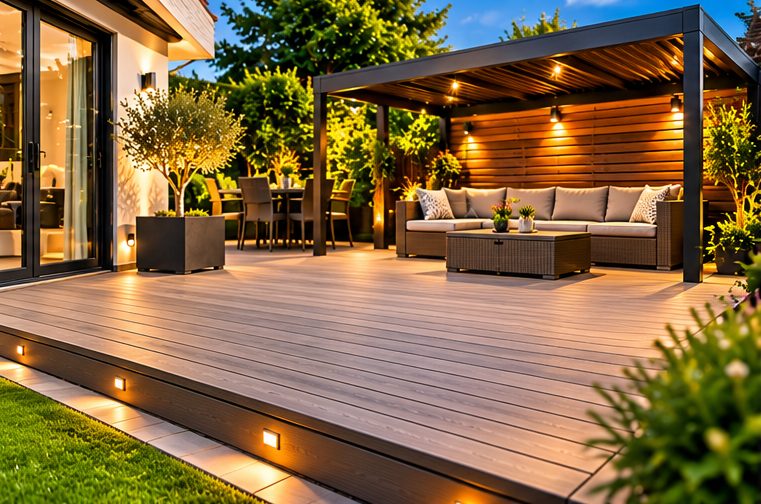
Few garden jobs split opinion like decking. Timber looks warm but weathers, greens over and needs regular attention. Composite boards, made from a blend of wood fibre and plastic or from solid plastic, promise a tidier, calmer life.
This guide looks at how composite garden decking is built, where it suits and where it does not, and what homeowners in Worcester, Evesham and Stratford-upon-Avon should check before booking anyone. It is practical rather than promotional, because the frame underneath matters just as much as the boards.
The main attraction is less upkeep. Timber needs cleaning, treating and sometimes sanding, and the surface can become slippery in a damp, shaded Worcestershire garden. Low maintenance composite decking usually needs only a sweep and an occasional wash with water and a soft brush. Boards do not splinter and do not need staining. They are not maintenance free, though: leaves, moss and pollen still collect in shade, and some surfaces show scuffs from furniture. Colour will also change slightly over the first months as the board weathers. Understanding that honestly at the start avoids disappointment later, and a sample board left outside for a few weeks is a cheap way to judge colour and feel.
Boards are either hollow or solid, and capped or uncapped. Capped boards have a protective outer layer that resists staining and fading better than older uncapped ranges. Hollow boards are lighter and generally easier to handle, while solid boards feel more substantial underfoot and often cut cleaner at the ends. Surface texture matters: a grooved face gives grip, while a brushed or wood-grain emboss looks more natural. Darker colours show dust and absorb more heat in sun. Choose the board that suits how you use the space, whether that is dining, a hot tub area or a quiet seat, not simply the nicest sample.
Composite is only as good as what carries it. A stable, level frame on proper foundations, set at the correct spacing for the board chosen, prevents bounce and sagging. Aluminium and treated timber frames are both used, and a weed membrane under the frame keeps growth from coming through. Boards need small gaps for expansion and a free flow of air and drainage beneath, so decking built tight to a wall or on solid ground with no ventilation can suffer. Hidden clips give a clean surface, while face screws are quicker but more visible. A competent Composite Decking Installation follows the manufacturer's instructions on spacing and fixing, because shortcuts here are the usual source of lifting, gaps and noise.
Before a single board is cut, look at where water goes. A deck in a low corner that floods needs ground drainage or a raised frame with proper fall. On sloping plots the frame can often be stepped, avoiding heavy earth moving. Shade and tree cover affect how often you will clean the surface, and overhanging branches drop debris and sap. If the deck adjoins the house, check that it sits below the damp proof course and does not block airbricks. Think about where furniture, planters and a barbecue will stand, since heavy items need extra frame support underneath.
Price depends on the area, the board range, the height of the frame and the amount of groundwork. Raised decks with steps, handrails or lighting involve more materials and time than a ground-level platform. Awkward access, removal of an old deck or patio, and the need to level or retain the ground all add labour. Edging details, such as picture-frame borders and fascia trims, take extra cutting. We would rather measure up on site and talk about what you want than guess from a plan on a phone, and we will explain the options before you decide.
If you are considering a new composite deck or replacing worn timber, tell us the size, how you plan to use it and any problems with the existing ground. We will visit, take measurements, and talk through board choices and frame options in plain language. Quotations are free, with no obligation, and we cover Worcester and the surrounding parts of Worcestershire, Herefordshire, Gloucestershire and north Warwickshire.
For composite garden decking in Worcester or the surrounding towns, call or WhatsApp 07542 451291, or use the form below and tell us about the job.
Images on this page are illustrations only.
See all Composite Decking Installers services in Worcester →
It depends on the product, the frame and how it is looked after. Quality capped boards on a well built frame can last many years with little attention. Poor ventilation, bad drainage or a weak frame will shorten that, whatever the boards are made of.
Any outdoor surface can become slippery with algae or damp leaves, especially in shade. Grooved or textured boards help, and regular sweeping and washing keeps grip good. It is worth testing a sample board when wet before choosing.
Sometimes, but only if the old frame is sound, level and well ventilated. Often it is wiser to build a fresh frame, because rot or movement in the old one will show through. We check the existing structure before recommending either route.
Tell us about the job and we will be in touch, usually the same day.
Prefer to talk? Call 07542 451291 or WhatsApp us.