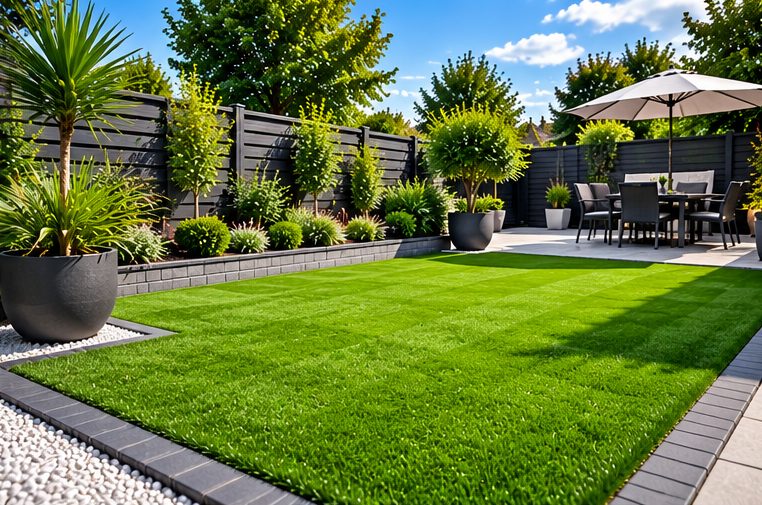
Plenty of people around Worcester have a lawn that never quite works: shaded under a fence, churned up by children, or simply too much weekend labour. Artificial grass for gardens can solve that, but it is not the answer for every plot, and it is worth being honest about where it suits and where it does not.
This guide walks through the points that decide a good result: the ground underneath, drainage, edges, the type of pile, and what the upkeep really involves. It is aimed at homeowners weighing it up in Worcester, Droitwich Spa, Kidderminster and the surrounding villages, before any firm decision is made.
Synthetic turf earns its place on small, shaded or heavily used lawns where real grass struggles. Narrow side returns, areas under trees, and play spaces that wear bare each winter all suit it. It is less convincing across a very large lawn, where the cost and the look of an unbroken plastic carpet can be hard to justify. It also does not suit gardens where roots of mature trees sit close to the surface, unless the base is designed carefully. Think about how you actually use the space. If you rarely walk on the lawn and just enjoy looking at it, real turf may still be the better answer.
The visible surface is only the top layer. What lasts is the base beneath it. The old lawn and topsoil are removed, a compacted sub-base is laid, and a finer layer is levelled over that. A properly built base drains freely, stays flat, and stops weeds pushing through from below. A thin or poorly compacted base gives ripples, soft patches and puddles within a season. In heavier clay soil, common in parts of Worcestershire, the sub-base may need to be deeper to help water escape. Always ask what depth and material is proposed, and how it will be compacted.
Samples are worth handling before you decide. Look at the pile height, the density of the fibres, and the backing. A mix of green shades with a slight brown thatch layer usually looks more natural than a single flat colour. Longer, softer piles feel pleasant underfoot but can trap leaves and show wear on paths where people walk. Shorter, denser grades handle traffic better. Check the sample outdoors in daylight, not under shop lighting. If you have a dog or young children, tell the installer early, since this affects the backing and the infill used.
Low Maintenance Artificial Lawns still need some care, just far less than a real one. Expect to brush the pile now and then to lift the fibres, remove leaves and debris, and rinse away mud or pet mess. Moss and algae can form in damp, shaded spots, so a mild cleaning treatment once or twice a year helps. You will not mow, feed or reseed. Weeds can still sit on top of the surface in wind-blown soil, but they pull out easily. Avoid placing hot barbecues or fire pits directly on it, as the plastic fibres can melt.
The main variables are the area, how much old turf and soil must be dug out and taken away, the depth of base needed, and the grade of grass chosen. Access matters too. If every barrow of material has to go through the house, the job takes longer. Edges, curves and joins add labour, as do raised borders or steps that must be worked around. Slopes need more care to keep the base stable. A free site visit lets the installer measure properly and see the soil, which is the only reliable way to price it.
Tell us roughly how big the lawn is, what it is used for, and whether pets or children will be on it. Photos help. We will visit, check the levels and drainage, show you samples, and put a written quote together that spells out the base depth and edging. There is no obligation, and if we think real turf suits you better we will tell you. Tap the call or WhatsApp button on this page to start.
For artificial grass for gardens in Worcester or the surrounding towns, call or WhatsApp 07542 451291, or use the form below and tell us about the job.
Images on this page are illustrations only.
See all Artificial Grass Installers services in Worcester →
It can, if the base is built for it. Water passes through perforations in the backing and then through a free-draining stone layer. Poor compaction or heavy clay without enough sub-base is the usual cause of puddles. Ask the installer how drainage will be handled in your soil.
Cheaper, flat, single-colour grass often does. A varied blend of greens with a natural thatch layer looks far more convincing. View samples in daylight, and keep in mind that good edging and a neat finish make as much difference as the grass itself.
That depends on the quality of the product, how heavily the lawn is used and how it is looked after. A well-laid lawn on a solid base can last many years. Heavy traffic on one route will wear that strip faster than the rest.
Tell us about the job and we will be in touch, usually the same day.
Prefer to talk? Call 07542 451291 or WhatsApp us.