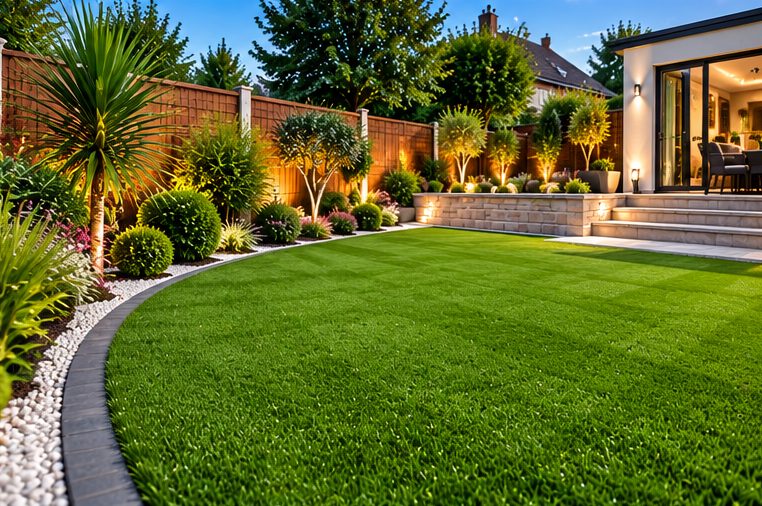
When a synthetic lawn goes wrong, the grass itself is rarely the culprit. Ripples, soft spots, standing water and weeds poking through nearly always trace back to what was done, or skipped, below the surface. Artificial lawn ground preparation is the unglamorous work that decides whether the finished surface still looks flat in five winters time.
Here we explain, step by step, what proper preparation involves, why gardens in Worcester and the surrounding counties vary so much, and which questions to put to anyone quoting for the work. If you are comparing quotes in Malvern, Evesham or Kidderminster, the base is where they tend to differ.
Preparation begins by looking at the existing ground. Is it level, sloping, soft, or made up of old paving and rubble? Does water sit there after rain? The old turf is stripped, usually to a depth that allows for the new base plus the grass itself, and the spoil is taken away. Tree roots, buried bricks and old concrete are dealt with at this stage. It is also the moment to check where downpipes and drains run, because you do not want to bury an inspection cover or block a soakaway. A shallow strip on a very uneven garden is a false saving.
A typical build uses a layer of compacted crushed stone, followed by a finer grade or sharp sand to give a smooth, firm finish. Each layer is spread, raked to fall and compacted with a plate machine, not just walked on. Depth depends on the ground. Free-draining soil may need less, while clay holds water and often needs a deeper, more open base. Where the lawn will be walked on constantly or take children's play equipment, a firmer base helps. Skipping compaction is the classic shortcut, and it shows up as dips within a few months.
A synthetic lawn should not be perfectly flat. A very gentle fall away from the house helps surface water run to a border or drain rather than sit against the wall. On sloping plots the base is cut into level steps or graded smoothly so the grass does not creep. Checking levels with a long straight edge and a laser or string line catches mistakes before the grass is down. Where a patio meets the lawn, the finished height should sit slightly lower than the paving so water does not run backwards.
A permeable weed membrane goes over the compacted base, laid flat and overlapped at the joins. It stops most weeds, though not every one, since seeds can land on top and root in the infill. Edges are then fixed. Treated timber, plastic or metal edging, or a concrete haunch where a border meets the grass, holds the perimeter so it does not lift. Pinning the grass straight to soil looks fine on day one, but the edges lift and wave within a year. Neat edging is also what makes the finished lawn look deliberate.
Preparation is often the largest part of the labour. What drives it is the depth to excavate, the volume of waste to remove, the type of base material, access for machinery, and whether levels need major correction. A tight garden with no side access means wheelbarrow work, which takes longer. Hard obstacles such as old patios add breaking-out time. When comparing quotes, ask each installer to state the base depth, the material, and the compaction method. A lower number that quietly leaves out depth is not the same job.
If you would like us to look at your garden, tell us its approximate size and anything you already know about drainage, trees or slopes. We will measure up, dig a test hole where it helps, and send a written quote setting out each stage of the base. Call or message us through the buttons on this page and we will arrange a free visit.
For artificial lawn ground preparation in Worcester or the surrounding towns, call or WhatsApp 07542 451291, or use the form below and tell us about the job.
Images on this page are illustrations only.
See all Artificial Grass Installers services in Worcester →
It depends on the soil and the use. The excavation must be deep enough for the stone sub-base, the levelling layer and the grass itself. Free-draining ground needs less than heavy clay. An installer should explain the depth they propose after seeing your garden.
That is not advisable. Old turf rots, settles unevenly and lets weeds through. The old lawn is normally stripped first and a compacted base is built in its place. Laying over it often leads to lumps and soft patches within a season.
Yes, in most cases. A permeable membrane stops the majority of weeds growing up from the soil. It will not stop windblown seeds rooting in the surface, but those are easy to pull. It should be laid flat and overlapped at the joins.
Tell us about the job and we will be in touch, usually the same day.
Prefer to talk? Call 07542 451291 or WhatsApp us.