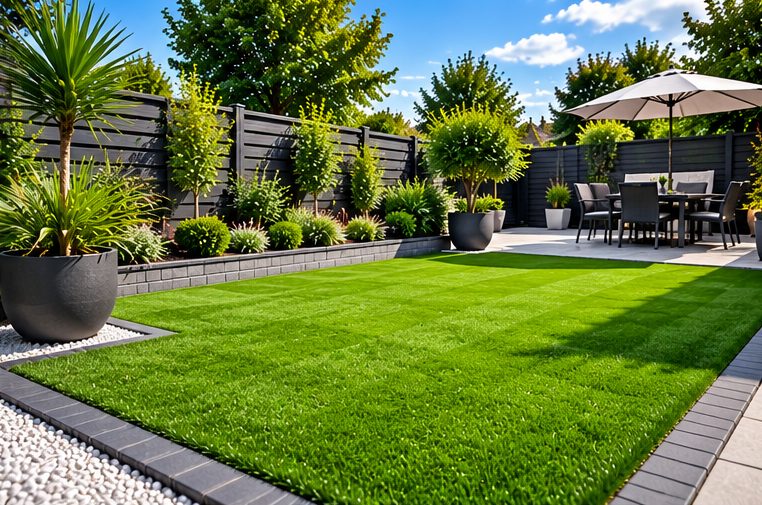
Synthetic lawns do not last forever. After enough summers of sun, foot traffic and weather, the blades flatten, the colour fades, seams open up and the surface begins to smell or grow moss. Many homeowners assume the only answer is to rip it all out and start again, but that is not always true, and it is certainly not always the lowest-cost path to a good result.
This guide looks at artificial grass replacement for gardens around Worcester, Droitwich Spa, Malvern and nearby villages. It helps you decide whether the turf, the base underneath or both need renewing, what removal involves, and how to choose a new product that suits the way you actually use the garden.
Wear is the first clue. Look at the areas that take the most traffic, such as the route from the back door, the space beside the patio and anywhere children or pets play. If the fibres are permanently matted, shiny or snapped off at the base, brushing will not bring them back. Other warning signs include backing that has become brittle, seams that have lifted despite re-gluing, patches of fading where the sun hits hardest, and a stale smell that returns after every clean. Cheap early products often had thin pile and weak backing, which is why they age faster. If only one corner is damaged, a repair is usually more sensible than full replacement, so it is worth being honest about how widespread the problem really is.
The turf is only as good as what it sits on. When an old lawn is lifted, the sub-base underneath tells you a lot. A firm, level, free-draining layer of compacted stone can often be reused after raking and re-compacting. Problems to look for include:
Removal is heavier work than people expect. Artificial grass is often glued, pinned and sometimes sand-filled, so it comes up in strips that are bulky and awkward. Infill such as silica sand makes the roll very heavy. Disposal needs care because the material is not accepted at every recycling point and cannot simply be left in a garden skip without checking. Once the grass is up, the base is inspected, repaired and brought back to level. This is the moment to fix drainage problems, install a better membrane, replace edging and add extra stone where needed, because it will be impossible to correct them later without lifting the new surface as well.
A new surface should be chosen for how the lawn is used, not just how it looks in a sample. Dense pile with a mix of fibre shades and a thatch layer looks more natural than a single flat green. A taller pile feels soft but can crush where there is heavy traffic, while a shorter, tougher pile suits busy family gardens. Dog owners should ask about perforated backing and drainage rates. Shade matters too, because gardens that stay damp need good airflow underneath. Ask to see a large sample outdoors and kneel on it, since a small swatch under showroom lights tells you very little about how it will look across a whole garden.
The size of the lawn is only one factor. The amount of old material to remove, how much sand infill it carries, whether the base must be rebuilt, the grade of replacement turf and the difficulty of access all change the price. Gardens with only a side passage mean everything is carried by hand, which takes longer. Curved edges and cut-outs around trees, planters or decking need more fitting and wastage than a simple rectangle. Seams, edging and extra drainage work add further time. Because the condition of the existing base is unknown until the old grass is up, a good quotation explains what is assumed and what would count as extra.
Contact SPR Trees and Landscapes and tell us how old the current lawn is, roughly how big the area is and what is bothering you most. Photos of the surface and the edges are useful. We will visit, check the condition of the base where it can be seen, discuss materials and give you a free, written quotation.
For artificial grass replacement in Worcester or the surrounding towns, call or WhatsApp 07542 451291, or use the form below and tell us about the job.
Images on this page are illustrations only.
See all Artificial Grass Installers services in Worcester →
Generally no. Laying over an existing surface hides faults, traps moisture and produces a lumpy, uneven finish. The old turf should come up so the base can be checked and corrected. Only then can the new lawn be fitted flat, drained and fixed properly at the edges.
It depends on the quality of the product, how much use it gets and how well it is looked after. Better quality turf on a sound base lasts considerably longer than thin budget versions. Regular brushing and keeping it free of debris helps slow down the visible ageing.
Smells usually come from pet urine, damp organic debris or a base that drains poorly. Regular rinsing and cleaning can help, but if the odour keeps returning, the backing or sub-base may be holding moisture and replacement of the lawn and base may be the better option.
Tell us about the job and we will be in touch, usually the same day.
Prefer to talk? Call 07542 451291 or WhatsApp us.