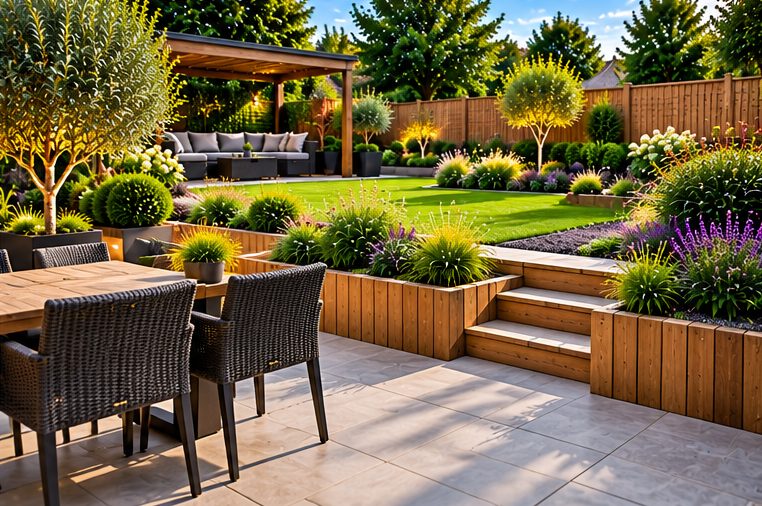
A small garden gives you little room to hide mistakes. A bad path, an oversized patio or one clumsy shed can dominate the whole space. The upside is that good choices show up immediately and the work is quicker to finish.
This guide looks at how Small Garden Landscaping is planned for terraces, townhouse yards and modern estate plots, with advice for homeowners in Worcester, Cheltenham, Droitwich Spa and elsewhere nearby. We keep it practical and talk about trade-offs rather than trends.
Before sketching a layout, list the jobs the space must do. A place to sit and eat, somewhere for the washing, bin storage, a bike shed, a few pots or a patch of lawn for children are all common. You will rarely fit everything, so rank them. A tiny plot that tries to hold a lawn, a patio, a shed and a deep border usually ends up feeling cramped and unsatisfying. Often the sensible answer is a single generous seating area with planting around the edge and storage tucked into one corner, rather than a bit of everything in small pieces. Be honest about how often you will really use each feature, because rarely used corners are the first place to save space.
Diagonal lines make small gardens feel longer, because the eye travels further than along a straight edge. A path that curves out of sight invites you to walk on. Slight changes of level, like a raised bed or a single step, add interest without needing space. Keep surfaces consistent so the garden reads as one room, and avoid cutting it into many small zones. Mirrors and vertical elements, such as trellis or climbers on fences, bring greenery without using floor area. Look at the view from the kitchen window too, since that is where the garden is seen most often. Keep the area nearest the house simple and open, and save the more detailed planting for the far end of the plot.
Large-format paving usually looks calmer than small units because there are fewer joins, though it can be harder to carry through a house. Gravel is easy to lay and forgiving of curves but can wander on to paths if not edged. Timber and composite decking work well on uneven ground. Hard landscaping should leave soil for planting wherever possible, as even a narrow border softens boundaries. Pick two or three materials and repeat them, rather than trying many, since variety looks fussy in a small footprint. Think carefully about drainage, as sealed surfaces shed more water than people expect. Light-coloured paving reflects daylight into shaded yards, while darker surfaces can make a narrow space feel smaller.
Choose plants for their habit as much as for their flowers. Slim shrubs, evergreen structure, climbers and pots allow variety without crowding. Avoid large trees that will shade the garden and reach the foundations. Built-in storage, benches with lids and slim sheds earn their keep in small plots. Privacy is often the biggest issue in terraced and estate gardens. Taller fence panels, trellis tops and well-placed screening plants can help, subject to height rules on boundaries. Always check what your boundaries allow before building upward. Wall-mounted planters and slim raised beds add colour while leaving floor space free for chairs and a table.
Surprisingly, small gardens are not always cheap to landscape. Access is the usual reason: if everything must be carried through the house or down a narrow alley, labour rises. Removing old paving, soil or an overgrown shed, changing levels and installing drainage all take time. Higher-quality materials and bespoke joinery add more. The more detail you have, the clearer the figure, so we measure, discuss materials and tell you where we see difficulties before quoting.
Send us a rough sketch or photos, along with a list of what you want the space to do. We will visit, measure the plot and suggest sensible layouts, being honest where the budget or the space limits an idea. Quotations are free with no obligation. We cover Worcester and the surrounding parts of Worcestershire, Herefordshire, Gloucestershire and north Warwickshire.
For small garden landscaping in Worcester or the surrounding towns, call or WhatsApp 07542 451291, or use the form below and tell us about the job.
Images on this page are illustrations only.
See all Landscaping services in Worcester →
It can, but a small lawn wears quickly and may need replacing sooner than a larger one. Many owners choose a patio with deep planting instead, or a compact lawn with a solid edge. We can talk through the compromise.
Simplify the layout, use diagonal lines, repeat a limited set of materials and add height with climbers. Keep clutter out of sight lines. Lighting and a clear view from the house also make the space feel generous.
Most garden work does not, but taller fences, large outbuildings and changes at the front of some properties can have rules. Leasehold and estate covenants may apply too. Check early so the design suits your boundaries.
Tell us about the job and we will be in touch, usually the same day.
Prefer to talk? Call 07542 451291 or WhatsApp us.