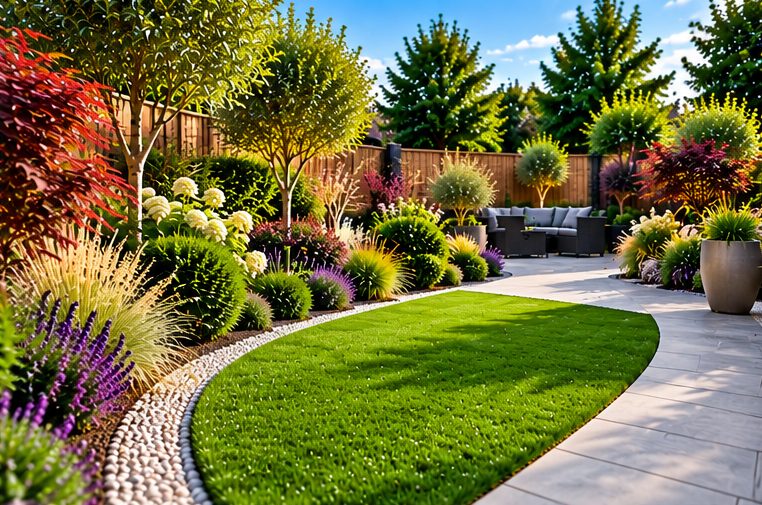
The front garden is the part of your home everyone sees and few people enjoy. It is often squeezed between the pavement and the front door, asked to hold bins, a car, a path and some greenery all at once. Good Front Garden Landscaping turns that muddle into something that works every day and looks tidy from the road.
Whether you live on a Victorian terrace near the centre of Worcester, a 1930s semi on the edge of Droitwich Spa, or a modern close, the same questions apply. This guide runs through them: parking, surfaces, drainage, boundaries, planting and the regulations that catch people out.
List the jobs first. Does it need to take one or two cars? Store wheelie bins out of sight? Provide a safe, level path for pushchairs or someone with limited mobility? Or is it mainly there to look good? Sketch the available space and move through it as you would on a normal day, from car to door and bins to kerb. Many unsatisfying front gardens fail because the design looked good but made daily tasks awkward. Settle the practical layout, then add the planting around it.
Hard surfaces in front gardens are limited by rules on surface water. Generally, a hard area bigger than a certain size needs either permeable materials or a way for rainwater to drain to a lawn or border, rather than straight to the road. Gravel on a proper base, permeable block paving and resin-bound surfaces are common options. Dropping the kerb to create a driveway needs approval from the highway authority, and cannot just be cut by a contractor. Check this before ordering anything, as it affects cost and timing.
Front gardens often slope toward the house or the road. Water should never be directed against the wall. Check that surfaces fall gently away from the doorway and that the finished level sits below the damp-proof course. Some gardens need a drainage channel across the end of a drive, or a soakaway. On steeper plots, steps and low retaining walls may be needed to make the path safe. Getting the levels right is dull work, but it is the part that keeps the garden dry and the house sound.
Low walls, hedges and railings define the front garden and set the tone for the street. Where the house sits close to the road, a hedge or tall planting can add privacy and soften noise, but should not block sightlines from the drive. Choose plants that suit the aspect and soil, with a mix of evergreen structure and seasonal interest. Compact shrubs, grasses and perennials look tidy with modest upkeep. Raised beds give good drainage on heavy clay. Keep the plants away from drains and walls where roots could cause trouble.
The biggest influences are the area, the type of surface chosen, the amount of digging and waste removal, and any changes to levels or boundaries. A new drive on a base that must be dug out and built up costs more labour than a simple path. Access for machines, the need for drainage, and whether walls and fences are included all matter. Lighting, bin stores and planting add to the total. A visit lets the contractor see the slope, the soil and the access, none of which is clear from a plan.
Practical extras make a front garden usable. A screened or recessed bin store keeps the street view tidy. Low-level lighting along the path helps visitors find the door safely and deters opportunists. Steps need handrails if the level change is significant, and a firm, non-slip surface matters in wet weather. Think about where post, deliveries and bikes will go. Ensure there is a clear path wide enough for a pushchair. Planning these small items at the start is far cheaper than retrofitting them once the surfaces are finished.
Send photos of the front of your property, a rough idea of the size, and your priorities, whether that is parking, low upkeep or appearance. We will visit, discuss options in plain language, and provide a written quote. We will also flag anything that needs permission before work starts. Use the call or WhatsApp buttons on this page to get in touch.
For front garden landscaping in Worcester or the surrounding towns, call or WhatsApp 07542 451291, or use the form below and tell us about the job.
Images on this page are illustrations only.
See all Landscaping services in Worcester →
Not always, but there are rules on drainage. A larger hard surface generally needs to be permeable or drain to a lawn or border. Dropping a kerb needs separate approval. Check with your council before work starts.
Permeable paving or gravel on a good base, with a few robust shrubs in borders and a hedge for definition, keeps work minimal. Avoid putting membrane under deep planting areas where roots cannot spread.
Often yes, but the surface needs to be built to suit the slope, with proper drainage and a safe gradient. Steep gradients may need regrading or retaining walls. A site visit is the sensible way to judge it.
Tell us about the job and we will be in touch, usually the same day.
Prefer to talk? Call 07542 451291 or WhatsApp us.