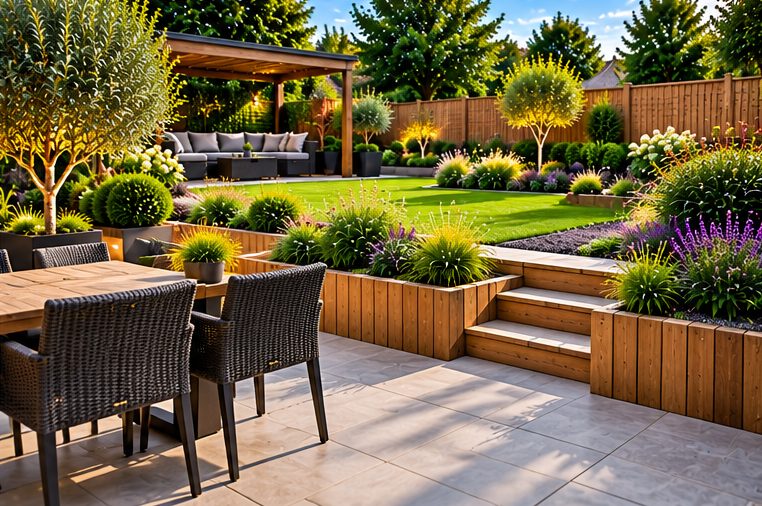
Nobody wants a garden that needs constant work, yet most gardens drift that way because they were never planned around the time the owner actually has. Low maintenance does not have to mean concrete and gravel. It means designing so that the jobs which take the most effort, such as mowing awkward corners, weeding, watering and clipping, are reduced or removed.
This guide is for homeowners in Worcester, Malvern, Evesham and nearby villages who would like a garden that looks tidy without a weekend of work. It explains how the design process helps, which decisions save the most effort, and how SPR Trees and Landscapes can quote for a plan that fits your routine.
The most useful first step is an honest audit. Walk the garden and note what takes your time: cutting the lawn, trimming a hedge, clearing leaves, weeding gravel, deadheading, or watering pots. Then think about what you actually enjoy. Plenty of people like a bit of planting but resent mowing a steep bank. Design can then target the real burdens. A lawn with fiddly edges can be simplified, a bed that needs constant weeding can be mulched or replanted, and a hedge that grows too fast can be swapped for a fence. Be realistic about how much time you will have in five years, not only now, because a garden has to suit later life too.
Shape drives upkeep. Simple, flowing lawn edges are quicker to mow than ones with many tight corners. A hard edge, such as a mowing strip, stops grass creeping into borders. Paths that follow natural routes reduce wear, and a hard-surfaced area close to the house gives somewhere to sit without any maintenance. Useful choices include:
Hard surfaces such as paving, porcelain, gravel or decking replace areas of lawn that need cutting. Each has its own upkeep: paving may need an occasional wash, gravel requires raking and a weed membrane, and decking needs checking for algae. Borders can be made much easier with dense planting, since closely spaced shrubs and ground cover leave less room for weeds. A layer of bark or mulch on top suppresses weeds and retains moisture. Raised beds put planting at a comfortable height. Artificial grass is an option for those who want a green surface with minimal work, though it is a different material with its own limits. The right mix depends on how you use the space.
Plants should be chosen for the conditions rather than for a catalogue picture. Sun, shade, soil type and wind all matter. Shrubs and perennials suited to heavy clay, which is widespread around Worcester, will survive with far less intervention than those that struggle. Evergreen structure, long-flowering perennials and ornamental grasses give shape across the seasons. Avoid fast, thirsty plants that need constant cutting back. Leave enough room for each plant to reach its natural size, so you are not pruning to fit. Automatic irrigation or a simple drip line for pots and beds can save a lot of time in dry spells, particularly if you travel in summer.
The amount and type of work changes the figure more than the size of the plot alone. Lifting an old lawn, building patios or paths, installing edging and membranes, buying planting and arranging irrigation all add up. Premium surfaces cost more than basic ones. Access, slopes, drainage and waste removal are further factors. A garden that is phased over a few months or years can be budgeted more flexibly. A visit is the surest way to see what is involved and to agree where to put the effort.
Contact SPR Trees and Landscapes, tell us which jobs bother you most and share photographs of the garden. We will visit, talk through what could be simplified and put together a free written quotation tailored to your time and budget.
For low maintenance garden design in Worcester or the surrounding towns, call or WhatsApp 07542 451291, or use the form below and tell us about the job.
Images on this page are illustrations only.
See all Landscaping services in Worcester →
Not at all. It means choosing plants that suit your soil and light, spacing them well and using mulch or ground cover to keep weeds down. A planted garden can be far easier to manage than a poorly designed one with lawn and gravel.
Well-laid paving or porcelain usually needs the least attention, with an occasional wash. Gravel needs raking and a good membrane, while lawn needs regular cutting. The right surface depends on how you want to use the area.
Yes. Many gardens can be simplified by reshaping the lawn, adding edging, thickening planting, replacing high-effort features and adding hard areas. You do not always need to start from scratch, and a phased approach works well.
Tell us about the job and we will be in touch, usually the same day.
Prefer to talk? Call 07542 451291 or WhatsApp us.