
Reduction is cheaper and keeps your screening. Removal costs more, loses the screen, and sometimes it's still the right call. The species usually decides which.
The short answer
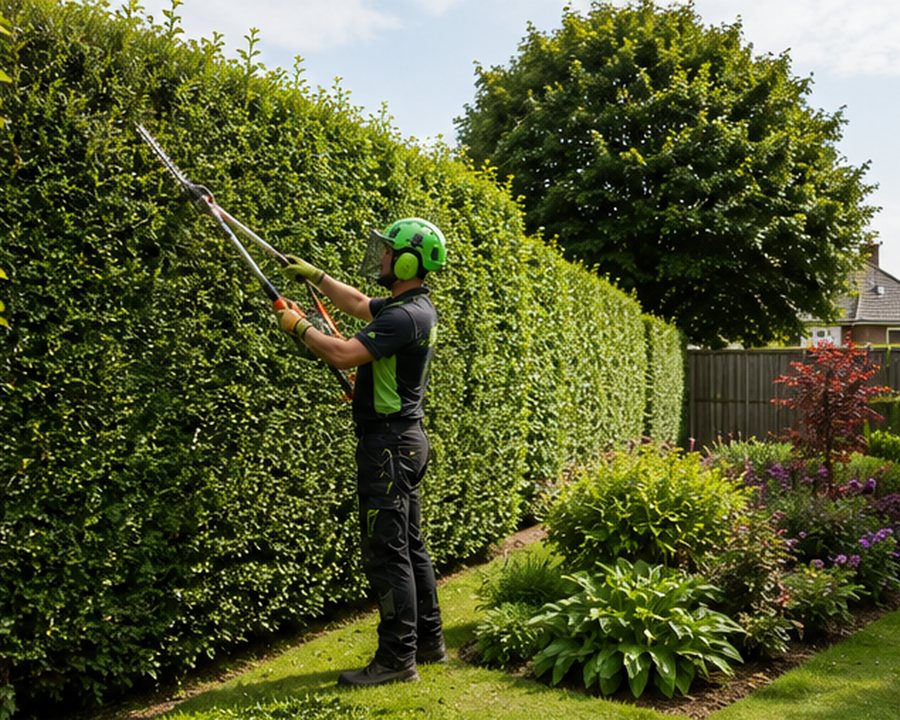
- Reduce where the species will regrow from where you want to cut — yew, privet, laurel, beech, hornbeam, hawthorn, holly and most native hedges.
- Consider removing where it won't — chiefly conifers that have outgrown their green growth — or where the hedge is failing, bare-based beyond recovery, or simply the wrong plant for the position.
The case for reducing
- Cheaper, considerably.
- You keep the screen — no gap, no waiting.
- Quicker; usually one or two visits.
- Established roots, so no establishment period and no watering.
- Less disruption to the garden and the boundary.
- And it's reversible in the sense that if it works, you've saved a great deal.
The case for removing
- You get the boundary you actually want, at the size and species you choose.
- A conifer past its green growth will never look right reduced — that's the clearest case.
- A bare, woody base doesn't recover after years of shading.
- You can pick a slower-growing species and cut the future maintenance sharply.
- Root and soil problems can be dealt with at the same time.
- And it's the moment to sort a fence line, if there's one behind it.
How to decide
| Situation | Usually |
|---|---|
| Yew, privet, beech, laurel, hawthorn — overgrown | Reduce |
| Leylandii, still green where you want to cut | Reduce, within the green |
| Leylandii, green only at the very top | Remove |
| Bare-based for years, no low growth | Remove, or replant the gaps |
| Dying, diseased or half dead | Remove |
| Right plant, wrong size | Reduce |
| Wrong plant for the position | Remove — you'll keep fighting it otherwise |
What removal actually involves
- Cutting down and removing the hedge — a substantial volume on a mature run.
- Dealing with the stumps and roots, by grinding or excavation.
- Improving the soil, which will be exhausted along the line.
- Replanting, at a spacing suited to the species — or fencing instead.
- Watering through the first year or two, which is a real commitment.
- Waiting. Three to five years to a decent screen, depending on species.
The option nobody suggests
There's frequently a third path. Reduce what's worth keeping and replant only the failed sections. Or plant a new hedge in front of, or alongside, the tired one — and remove the old one in two or three years once the new planting has established.
If you replace, choose better
- Match the growth rate to the maintenance you'll actually do — Leylandii is fast because it never stops.
- Yew for a formal evergreen screen: slow, but one cut a year and it takes hard pruning.
- Beech or hornbeam for a deciduous hedge that holds leaf through winter.
- Native mixed for wildlife and low maintenance.
- Laurel for fast dense evergreen, given the room.
- And think about final size, not planting size.
Or replace it with a fence
Worth considering if what you actually want is the ground back. A fence occupies the thickness of a post where a mature hedge takes a metre or more of depth plus its dry shadow. You lose the height above fence limits, the wildlife value and the softness — but planting in front of a new fence recovers some of that over a few years. SPR covers fencing as well, so it can be the same project rather than two.
Deciding what to do with a hedge?
We'll assess it and tell you honestly which way we'd go, including if that's leaving it alone.