
Length is what people measure when they ring. Height and how long the hedge has been left are what actually decide the price.
We don't publish a fixed price list for hedge work, because the length is only one part of it — height, condition, access and how much material comes out all move the number considerably. What we can do is set out what to look at before you ring round.
The factors, roughly in order of impact
- Height. Above head height the work needs platforms or towers, and that set-up applies along the whole run.
- Condition. An annual trim and a three-year catch-up are genuinely different jobs.
- Length. The baseline — though usually less decisive than the first two.
- Number of faces. One side, two sides and a top are three different amounts of work.
- Species. How dense the growth is, and how pleasant it is to handle.
- Access. Room to work, room to place a platform, and a route for the waste.
- Waste. Cuttings are bulky, and removing them is a real part of the cost.
How long since it was cut?
This is usually the quickest way to work out what you're actually asking for.
| Since the last cut | What the job becomes |
|---|---|
| Under a year | Straightforward trim |
| One season missed | Heavier cut, noticeably more material |
| Two years | Borderline — reduction rather than trimming |
| Three years or more | Restoration; saws, platforms, a lot of waste |
| Five years or more | A different scale of job entirely |
People often describe a hedge as needing a trim and then mention it hasn't been cut since they moved in four years ago. At that point it's a reduction, and the quote reflects that — so it's worth being straight about it up front.
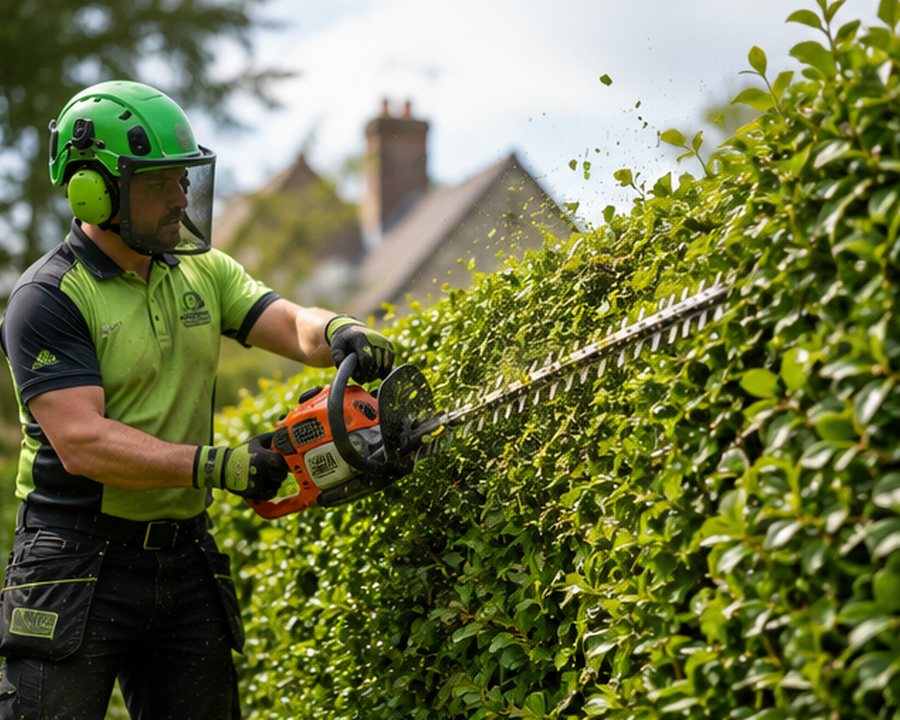
Species makes a difference
- Privet — cuts easily, and comes back quickly.
- Leylandii and conifers — fast, soft growth, but they won't reshoot from bare wood, which limits what's possible on a neglected one.
- Beech and hornbeam — denser work, but a fine hedge when maintained.
- Laurel — large leaves; on a formal hedge, secateurs give a much better finish than shears.
- Yew — slow-growing, and the one conifer that regrows from old wood.
- Holly — slow, and genuinely unpleasant to handle.
- Hawthorn and native mixed — tough, usually cut in winter.
Access and waste
- Can equipment reach the hedge, or does everything go through the house?
- Is there room to place a platform along the run?
- Is one face on a neighbour's land, needing arranging?
- Is there a border, pond or greenhouse beneath that needs protecting?
- Where can a vehicle stop for loading the arisings?
- Is there anywhere on site the chip could stay, if you'd like it?
Why regular cutting costs less
- Less material to cut and remove each time.
- Ground-level work stays possible for longer.
- The hedge stays dense rather than going bare at the base.
- No risk of cutting into bare wood on a conifer.
- The shape is maintained rather than rebuilt.
Getting a useful quote
- Rough length, in metres or paces.
- Rough height — against a door or fence is a fine guide.
- How long since it was last cut, honestly.
- The species, or a photograph.
- How many faces need doing.
- Whether the far side is reachable.
- Whether trees also need attention at the same visit.
Want a free quote on your hedge?
Tell us roughly how long it is, how tall, what species if you know, and honestly how long since it was last cut. That's enough for a sensible quotation.