
Leylandii is the fastest-growing hedge most people own, and it's quoted on the same basis as any other — length, height, condition, access and waste. What makes it different is how quickly the condition changes if it's left.
We don't publish a fixed price list for hedge work, because the length is only one part of it — height, condition, access and how much material comes out all move the number considerably. What we can do is set out what to look at before you ring round.
Why Leylandii is its own case
It was planted almost everywhere as a fast privacy screen, and it does that job extremely well. It only becomes a problem when the maintenance stops — and unlike most hedges, the damage from missing a few years can't be undone.
How often it needs cutting
| Frequency | What happens |
|---|---|
| Two or three cuts a year | Stays dense, stays reducible, stays easy |
| Once a year | Manageable, but gains height and width steadily |
| Every other year | Cuts get heavier; green retreats outward |
| Every three years | Reduction rather than trimming |
| Left five years or more | Green only at the surface — options now limited |
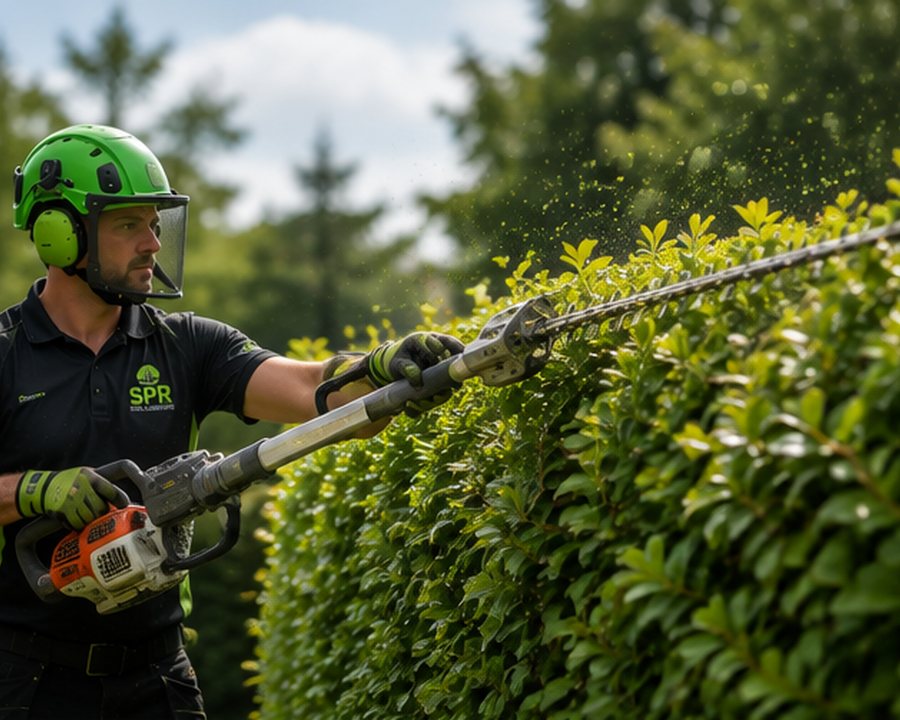
What drives the cost
- Length and height — height especially, since above head height needs platforms.
- How long since the last cut.
- Number of faces, and whether the neighbour's side is reachable.
- Waste volume, which on Leylandii is substantial — it's bulky, soft growth and there's a lot of it.
- Access for the vehicle and somewhere to load.
- Whether the top needs doing as well as the sides.
Cut with a taper
Leylandii responds well to being cut slightly narrower at the top than the bottom. That taper lets light reach the base, which is what keeps the lower growth dense. A hedge cut square — or worse, wider at the top — shades out its own base until it goes bare and woody, and on a conifer that bare base doesn't recover.
Height, and the neighbours
Leylandii is the species most often behind a neighbour disagreement, simply because it gets tall quickly. Where an evergreen hedge over two metres blocks light to a neighbouring property and the parties genuinely can't resolve it between them, there's a formal complaint route through the local council — it carries a fee and requires evidence that you tried to sort it first.
In practice almost every case is better settled by agreeing a reduction voluntarily, and the cost is often shared. This is general information rather than legal advice.
If yours is already overgrown
- Check where the green stops — that's the whole scope of what's possible.
- If there's green depth to work with, reduce it once and then maintain from there.
- If the green is only at the surface, reduction won't achieve what you want.
- In that case, replacement is worth considering honestly rather than trimming something nobody's happy with.
- Either way, get onto a two-or-three-cuts-a-year cycle afterwards.
Leylandii getting away from you?
Tell us the length and rough height and we'll arrange a free quotation.