
Height can usually be brought down. Whether it can come down as far as you'd like depends almost entirely on the species — so that's the first thing to establish.
How it happens
Almost always the same way: the top gets out of comfortable reach, so the annual cut gradually becomes a sides-only cut, and the hedge gains height every year after that. It's rarely a decision anybody made.
What can safely come off
| Hedge | How far it can be lowered |
|---|---|
| Privet | Very hard; extremely forgiving |
| Yew | Hard — the conifer that regrows from old wood |
| Laurel | Hard; responds strongly |
| Beech, hornbeam | Hard, better staged if severe |
| Hawthorn, blackthorn | Hard |
| Holly | Reasonably hard, but slow work |
| Leylandii, cypress | Only into green growth |
Cut lower than your target
Whatever height you cut to, the hedge grows from there. Cutting to exactly the height you want means it's above that within a season and you're back to a reduction rather than a trim. Coming down a little further buys several years of simple maintenance at the height you actually wanted.
Do the sides at the same time
Lowering the top alone often looks worse than doing neither, because the proportions go wrong — a tall narrow hedge becomes short and wide. Worth quoting both together even if you only do the top this year.
If it's the neighbour's hedge
Where an evergreen or semi-evergreen hedge of more than two metres blocks light to your property, and you genuinely can't resolve it between you, local authorities have a formal high hedge complaint process.
- It applies to evergreen and semi-evergreen hedges of two or more trees or shrubs.
- Over two metres tall.
- Acting as a barrier to light or access.
- You must show you tried to resolve it first — it's not an opening move.
- Councils charge a fee to consider a complaint.
- A single tree isn't covered by this process.
- The council can require a reduction, but not below two metres.
This is general guidance rather than legal advice; your local authority is the authority on any specific complaint.
If someone complains about yours
- Take it seriously and early. A voluntary reduction is far cheaper than a formal process.
- Get the species assessed — you may be able to explain what's genuinely possible.
- A reduction may improve your own garden's light too.
- Offer to share the cost if the hedge serves both sides.
- Put whatever you agree in writing, however informally.
What a reduction involves
- Assessing the species, condition and how far the green extends.
- Agreeing the finished height and the likely appearance.
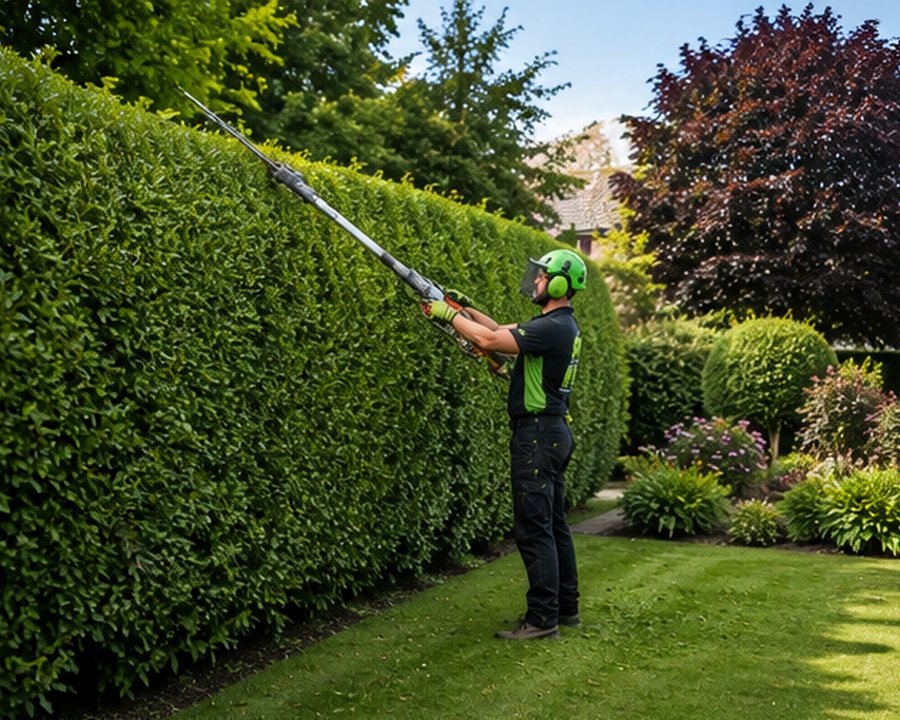
- Working at height along the run.
- Cutting to a consistent line with a slight taper.
- Clearing and removing a substantial volume of arisings.
- An honest view on whether the base will recover.
Hedge got beyond reach?
Tell us the species and the height you'd like, and we'll say honestly whether it's achievable.